
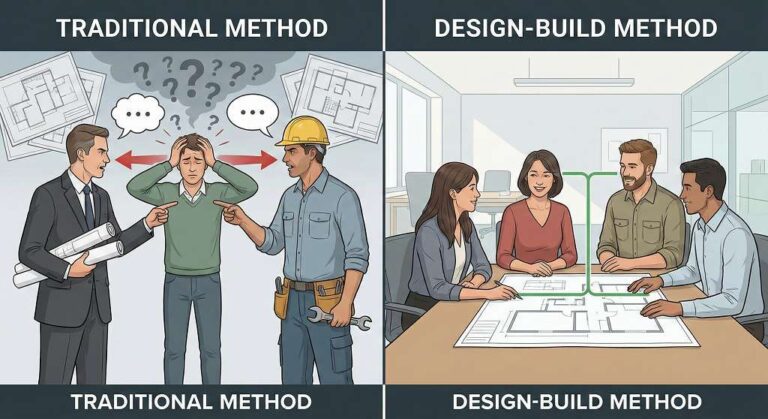
The main difference between design-build and a general contractor is who handles design. A general contractor builds from plans created by someone else. A design-build firm handles plans in-house and builds from them. This means one team is in charge of everything.
Are you planning a kitchen remodel, bathroom renovation, or home addition? If so, you might be thinking about which approach is best. The answer depends on your project’s complexity. It also depends on your budget and how involved you want to be with different professionals.
Here’s a clear look at design-build and general contractor methods. We’ll see when each approach works best.
Quick Definitions
What is a General Contractor?
A general contractor is a construction professional who manages the building phase of your project. They hire subcontractors like electricians, plumbers, and carpenters. They also get permits and make sure the work meets code. However, they typically don’t provide design services, you need to bring them finished plans.
What Is a Design-Build Firm?
A design-build firm combines design and construction under one roof, one contract, one team, one party accountable. Learn more about how design-build works →
Design-Build vs. General Contractor: Side-by-Side Comparison
| Factor | General Contractor | Design-Build Firm |
| Design services | Not included, hire separately | Included in-house |
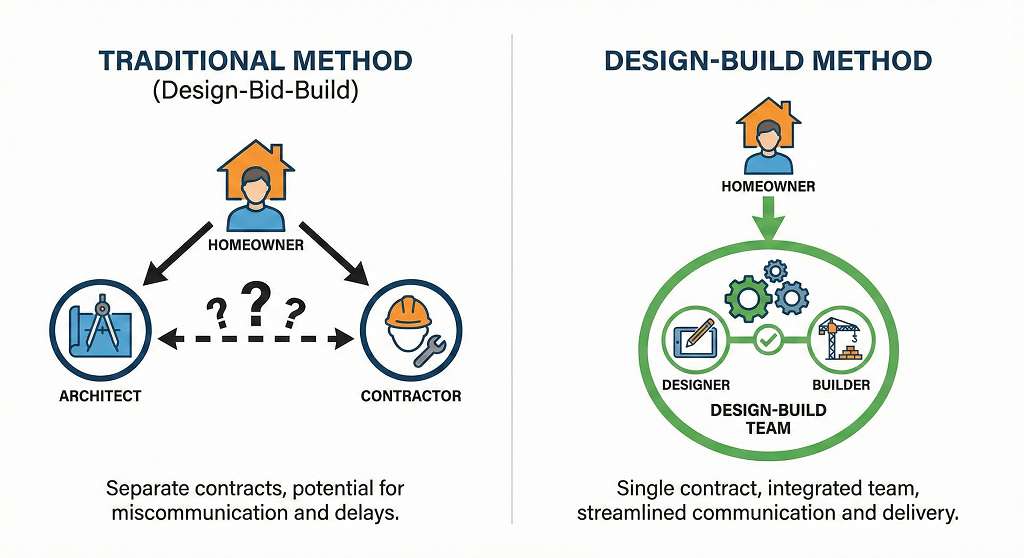
| Contracts | Multiple (designer + contractor) | Single contract |
| Communication | You coordinate between parties | Single point of contact |
| Budget accuracy | Unknown until bids come back | Priced during design phase |
| Timeline | Sequential (design, then bid, then build) | Overlapping (30% faster typically) |
| Change orders | Common (~5% cost increase avg) | Minimized (issues caught in design) |
| Accountability | Split between designer and builder | Single firm responsible for all |
| Best for | Simple projects with existing plans | Complex remodels needing design |
Cost Comparison: Design-Build vs. General Contractor
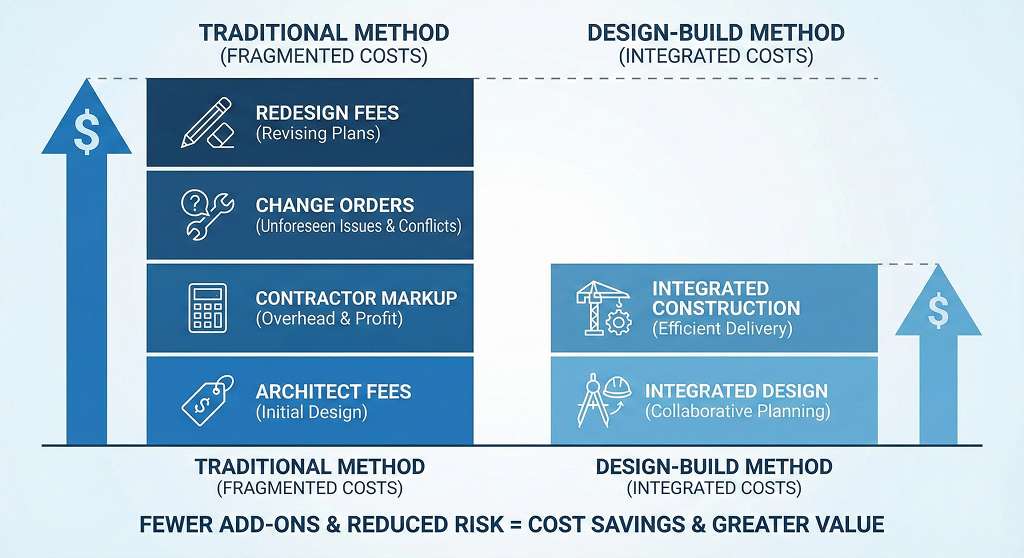
When comparing design-build vs general contractor costs, you need to look at the total picture, not just initial quotes.
Traditional Route (Architect + General Contractor)
- Architect/designer fees: 10% to 15% of construction cost
- General contractor markup: 15% to 25% for overhead and profit
- Change orders: Average 5% added to final cost
- Redesign fees: If bids exceed budget, you may pay twice for design
Example: For a $150,000 kitchen remodel, you might pay $15,000-$22,500 in architect fees before construction even starts. If contractor bids come back at $180,000, you either pay $30,000 more than expected or pay again to redesign.
Design-Build Route
- Design fees: 8% to 15% (integrated into the project)
- Construction management: 15% to 20% (covers overhead and profit)
- Change orders: Minimal (issues caught during design)
- Fixed-price contracts: Available from most design-build firms.
Example: That same $150,000 kitchen remodel gets priced during design. You know the real cost before signing the construction contract, and the firm is accountable for delivering at that price.
Bottom line: Design-build projects usually cost 6% to 20% less than traditional methods. This is true when you look at final costs, not just initial proposals.
The Communication Problem
Miscommunication between designers and builders causes 48% of all construction rework in the United States, totaling $31.8 billion annually. This is the hidden cost of separating design and construction.
Here’s how it typically plays out:
Traditional Approach
- An architect creates your dream kitchen but doesn’t know the exact building cost.
- You send plans to three contractors for bids.
- Bids come back 20-40% higher than the architect estimated.
- You either pay more, cut features, or start over with revised plans.
- During construction, the contractor finds issues with the plans.
- Change orders pile up. Architect and contractor blame each other.
Design-Build Approach
- Designer and builder collaborate from day one.
- Costs are estimated in real-time as design develops.
- If something’s too expensive, you know immediately, not after plans are finished.
- Final design matches your budget before construction starts.
- Construction team already knows the plans intimately.
- Issues are rare, and when they happen, one company is accountable.
When to Choose a General Contractor
A general contractor makes sense when:
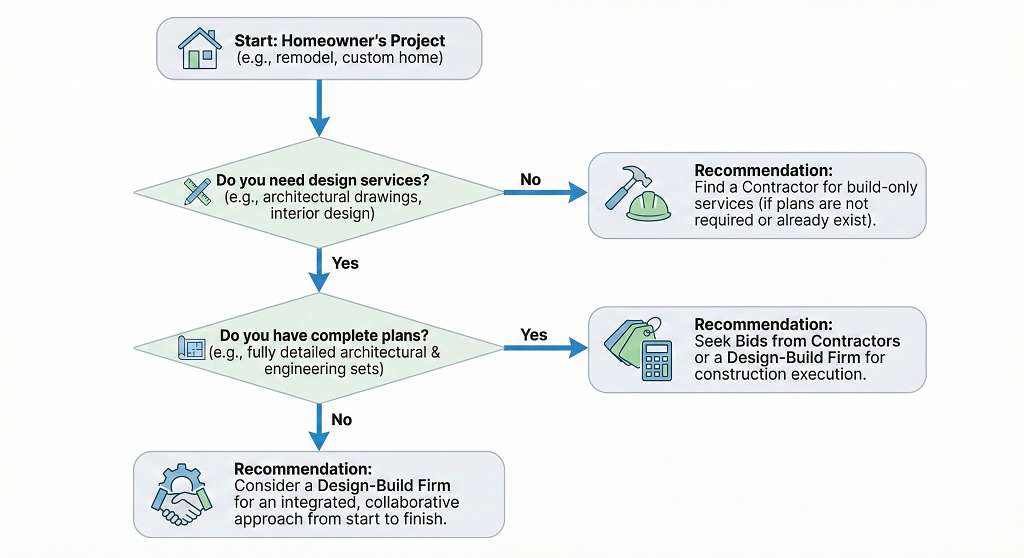
- You already have complete plans: If an architect has already designed your project with detailed specifications, you just need someone to build it.
- The project is straightforward: Replacing a deck, installing new flooring, or other projects that don’t require design services.
- You want competitive bids: Insurance claims sometimes require multiple contractor bids.
- You enjoy project management: Some homeowners prefer being deeply involved in coordinating contractors.
When to Choose a Design-Build Firm
A design-build firm makes sense when:
- Your project needs design work: Kitchen remodels, bathroom renovations, additions, and whole-house projects where layout and aesthetics matter.
- Budget certainty is important: You want to know the real cost before committing to construction.
- You value your time: One phone number to call, one team to manage, one party responsible.
- The project is complex: Multiple rooms, structural changes, or projects where design and construction decisions are deeply intertwined.
- You want accountability: No finger-pointing between separate contractors when issues arise.
How to Decide: 5 Questions to Ask Yourself
Question 1: Do I need design services?
If yes, design-build is usually more efficient. If you already have complete plans you’re happy with, a general contractor may be sufficient.
Question 2: How important is budget certainty?
If you need to know the exact cost before starting, design-build’s integrated pricing is a major advantage. Traditional methods don’t reveal true costs until bids come back, often too late to change course easily.
Question 3: How much time do I have to manage this project?
Traditional approaches require you to coordinate between architect and contractor. Design-build gives you one point of contact.
Question 4: How complex is my project?
Simple projects (new flooring, deck replacement) work fine with general contractors. Complex projects (kitchen remodels, additions, whole-house renovations) benefit from design-build’s integrated approach.
Question 5: What’s my risk tolerance?
With traditional methods, the homeowner bears more risk of cost overruns and coordination failures. Design-build shifts more of that risk to the firm.
Not sure which approach is right for you?
At College City Design-Build, we’re ready to talk about your project. We’ll honestly see if design-build fits your needs. Sometimes a general contractor is the right choice, and we’ll tell you that.
Call us at (952) 469-6900 or schedule a free consultation to discuss your project.
Frequently Asked Questions
What is the main difference between design-build and a general contractor?
A general contractor only handles construction, they build from plans created by someone else. A design-build firm manages both design and construction in one contract. This means one team is responsible for the whole project, from idea to finish.
Is design-build more expensive than hiring a general contractor?
No. Design-build usually costs 6% to 20% less than the traditional method. This is when you consider architect fees, change orders, and possible redesign costs. Initial quotes may look similar, but final costs are usually lower with design-build.
How much does a general contractor charge?
General contractors typically charge 15% to 25% markup on labor and materials, plus permit fees and subcontractor costs. For a $100,000 project, expect the contractor’s overhead and profit to add $15,000 to $25,000. This doesn’t include architect fees if design work is needed.
How much does a design-build firm charge?
Design-build firms typically charge 8% to 15% for design services and 15% to 20% for construction management. These are integrated costs. The total is usually lower than hiring an architect and a general contractor separately. This is because there are fewer change orders and better cost control.
Can I get multiple bids with design-build?
Yes, but the comparison works differently. With design-build, you compare full proposals. This includes both design services and construction, not just construction bids. The firms are competing on value, creativity, and reliability, not just the lowest price for identical plans.
What projects work best with each approach?
General contractors are great for projects with plans. This includes deck replacements, flooring installation, and simple additions from stock plans.
Design-build works well for complex projects that need custom designs. This includes:
– Kitchen remodels ($75,000 – $200,000+)
– Bathroom renovations ($30,000 – $100,000)
– Home additions ($100,000-$300,000+)
– Whole-house remodels ($200,000 – $500,000+)
About the Author
This article was written by the team at College City Design-Build, a design-build remodeling firm based in Lakeville, Minnesota. With over 25 years serving the Twin Cities, we’ve completed hundreds of kitchen remodels, bathroom renovations, home additions, and whole-house projects. We’re members of NARI (National Association of the Remodeling Industry), BATC (Builders Association of the Twin Cities), and maintain an A+ rating with the BBB.