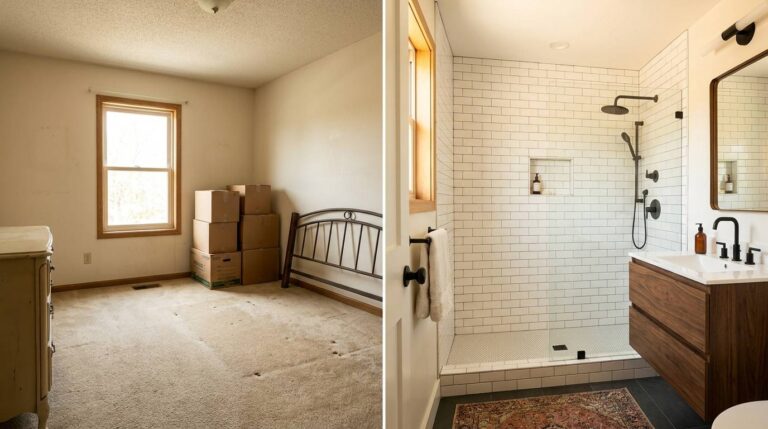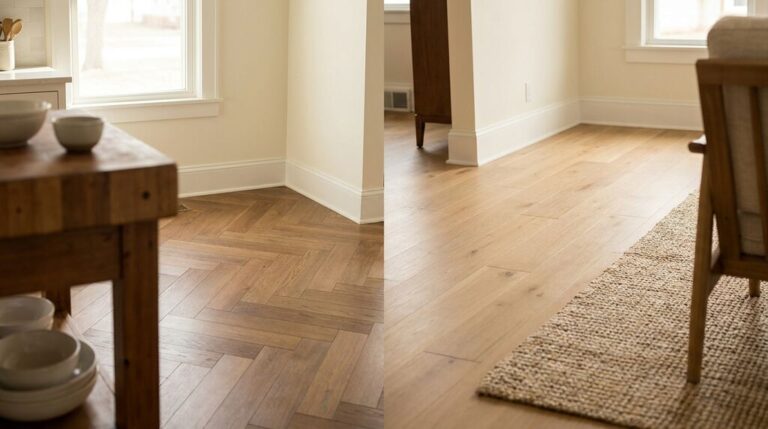
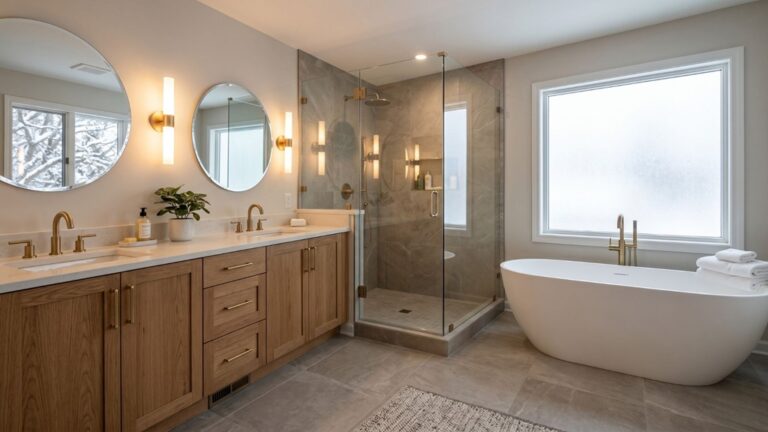
What you need to know now about bathroom remodeling in Minnesota.
- Most 2026 Minnesota bathroom projects fall between $13,000 for standard refreshes and $28,000 for master suites, though high-end gut renovations frequently clear $60,000.
- Expect to pay a 6% premium over national averages due to $51/hour skilled labor rates and the logistical hurdles of a compressed northern build season.
- Labor is your heaviest line item, typically consuming 40% to 50% of your total spend, followed by the shower system which can run up to $20,000 alone.
- Planning for a 20% contingency isn’t a suggestion in Minnesota; it is a necessity to address the subfloor rot and outdated electrical work common in our aging housing stock.
Read on to discover how to navigate the specific challenges of the Minnesota market without overpaying or cutting corners.
What Is a Realistic Budget for a Bathroom Renovation?
A realistic bathroom renovation budget in Minnesota starts at $8,000 for a cosmetic refresh and runs to $40,000+ for a full primary suite gut renovation. Most homeowners in the Twin Cities spend $13,000 to $19,000 on a standard full bathroom remodel in 2026.
Budget Tiers for Minnesota Bathrooms
- Cosmetic refresh ($5,000-$10,000): Paint, new vanity, fixtures, hardware, lighting. No tile, no plumbing moves.
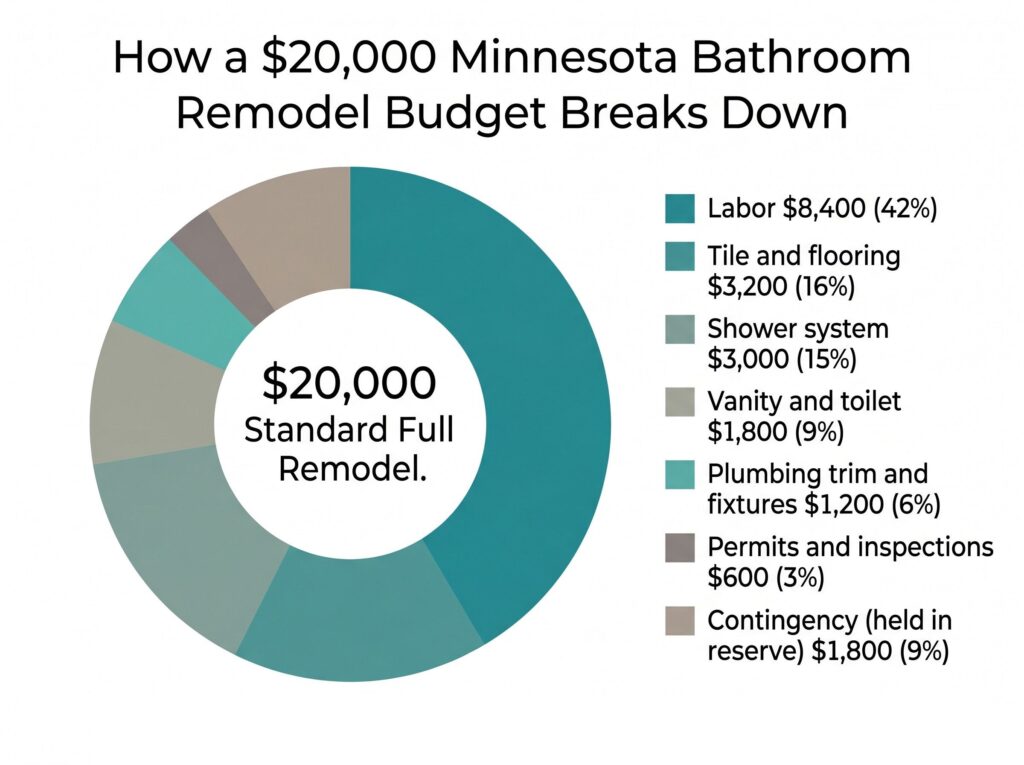
- Standard full remodel ($11,000-$19,000): New tile, shower or tub replacement, vanity, toilet, flooring. This is where most Minneapolis projects land.
- Full gut renovation ($20,000-$35,000): Everything out. New subfloor, plumbing rough-in, electrical, full tile.
- Primary suite / luxury ($35,000-$60,000+): Custom shower system, heated floors, freestanding soaking tub, high-end finishes.
The number that matters most: your contingency.
Budget 15-20% above your estimate for what is behind the walls. In Minnesota’s older housing stock, expect subfloor moisture damage, galvanized plumbing that needs replacing, or outdated electrical in the bathroom that fails current GFCI requirements.
What Is the Average Cost of a Bathroom Remodel in Minnesota?
The average bathroom remodel in Minnesota costs $13,000 for a standard bathroom and $28,000 for a master or large bathroom, according to local contractor data compiled for the Twin Cities metro area. Full project ranges run $8,480 to $37,100 per CostFlowAI’s 2026 Minnesota construction cost report.
Minnesota sits 6% above the national average in construction costs. That gap comes from three things: BLS-tracked skilled labor rates averaging $51/hour, a short viable build window (roughly April to November for exterior work), and permit requirements that vary meaningfully between Minneapolis, St. Paul, and surrounding suburbs.
What Minnesota Bathroom Remodels Cost vs. National Average (2026)
| Project Type | National Average | Minnesota Average | What Adds the Difference |
|---|---|---|---|
| Cosmetic refresh | $3,000-$10,000 | $5,000-$12,000 | Higher labor rates |
| Standard full remodel | $10,000-$25,000 | $13,000-$28,000 | Permit fees + labor |
| Primary suite gut reno | $30,000-$60,000 | $35,000-$65,000 | Heated floor systems, frost-depth work |
| Per sq ft (mid-range) | $180-$280 | $200-$310 | Regional cost multiplier 1.06x |
What Is the Most Expensive Part of a Bathroom Renovation?
Labor is the largest single cost in a bathroom remodel, representing 40-50% of the total budget. Within materials, the shower is the most expensive element. A fully tiled walk-in shower with frameless glass runs $8,000-$20,000 installed.
The Real Cost Hierarchy
- Labor: 40-50% of total project cost. Plumbers in Minnesota run $85-$175/hr in 2026, up 8-10% from 2025 per USACabinetStore.
- Shower: Prefab surround $1,500-$4,000 installed. Full tile walk-in with frameless glass: $8,000-$20,000.
- Moving plumbing: Every plumbing relocation adds $3,000-$15,000. Keep the toilet in place if you can.
- Tile: Material difference between ceramic ($1-$3/sq ft) and large-format stone ($8-$25/sq ft) adds $5,000-$15,000 across a full bathroom.
- Subfloor repair: Discovered during demo on roughly 50-70% of full tile-out projects. Adds $500-$3,000.
Planning a bathroom addition rather than a remodel? See what a basement bathroom addition actually looks like from start to finish. Read: Basement Bathroom Addition →
What Flooring Is Best for a Bathroom?
Porcelain tile is the best bathroom flooring for Minnesota homes because it handles moisture, freeze-thaw cycling, and heavy foot traffic better than any alternative. Luxury vinyl plank is the best budget option. Natural stone looks excellent but requires annual sealing and costs more to install.
Bathroom Flooring Options Compared
| Flooring Type | Cost Range (Installed) | Moisture Resistance | Minnesota Winter Performance | Lifespan |
|---|---|---|---|---|
| Porcelain tile | $8-$22/sq ft | Excellent | Excellent (freeze-thaw stable) | 20-50 years |
| Ceramic tile | $5-$14/sq ft | Excellent | Good | 10-20 years |
| Luxury vinyl plank (LVP) | $4-$12/sq ft | Very Good | Good (slight flex in cold) | 10-20 years |
| Natural stone | $15-$40/sq ft | Good (requires sealing) | Good with sealer | 20+ years |
| Heated tile (radiant) | +$8-$18/sq ft | Excellent | Outstanding | 20-30 years |
One note on Minnesota specifically: heated bathroom floors are not a luxury here, they are a quality-of-life upgrade that changes how a bathroom feels from November through March in a way that is hard to overstate. We see it on almost every primary suite renovation we do.
How Much Does It Cost to Rip Out and Replace a Bathroom?
Ripping out and fully replacing a standard bathroom in Minnesota costs $13,000-$28,000, including demolition, disposal, waterproofing, new tile, fixtures, vanity, toilet, and labor. The demo itself runs $500-$2,500. What you find underneath is where the budget variance happens.
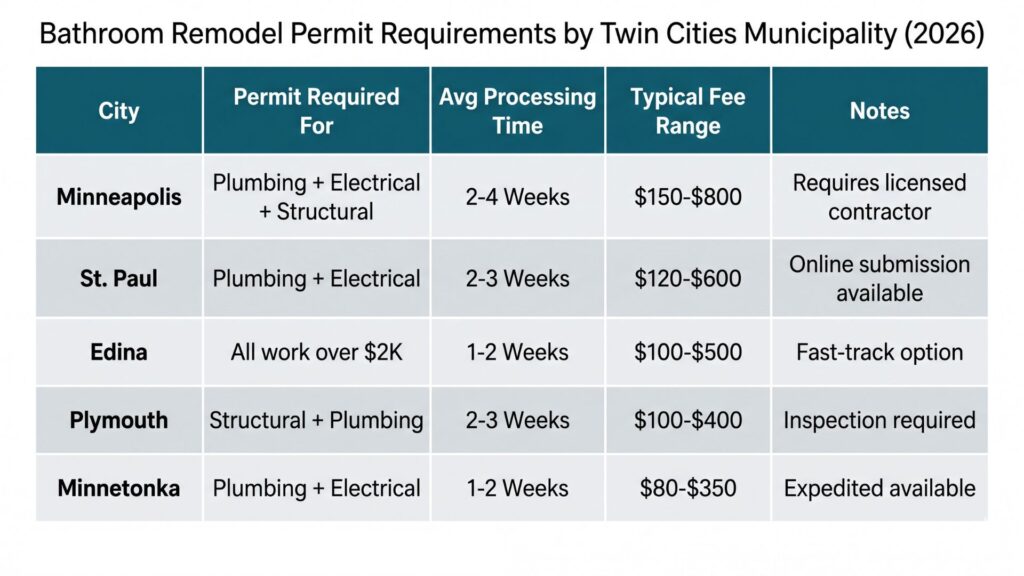
Full bathroom rip-and-replace projects in Minneapolis typically take 3-5 weeks from demolition to final inspection. The timeline depends on permit wait times in your municipality, which currently run 2-4 weeks in Hennepin County.
What demo typically reveals in Minnesota older homes:
- Subfloor moisture damage from years of grout failure
- Cast iron drain lines that need replacement before new tile can go down
- Outdated GFCI electrical that requires correction before permits close
- Galvanized supply lines with reduced flow that should be upgraded while walls are open
None of these is catastrophic. All of them cost money if they are not planned for.
Working with a smaller bathroom footprint? Storage strategy changes everything in a compact space. Read: Small Bathroom Storage Solutions →
What Is the Best Time to Renovate a Bathroom in Minnesota?
The best time to renovate a bathroom in Minnesota is January through March, when contractors have the most availability and scheduling pressure is lowest. Spring and fall are peak seasons, which means longer lead times and sometimes higher subcontractor rates.
Bathroom Remodel Timing in Minnesota
- January-March (Best): Lowest contractor demand, best scheduling flexibility, no competition with exterior projects
- April-June (Busy): Demand picks up fast as exterior season opens; book 6-8 weeks in advance
- July-September (Peak): Highest competition for contractors, longest lead times, highest subcontractor rates
- October-December (Good): Interior work ramps up as exterior season closes; availability improves
One thing that catches projects off guard: material lead times for custom tile, specialty fixtures, and frameless glass shower enclosures run 4-8 weeks regardless of season. Order before demo starts. We have seen projects delayed 3 weeks because the tile arrived after the subfloor was already prepped.
What Are Common Bathroom Remodel Mistakes?
The most common bathroom remodel mistakes are underbudgeting, moving plumbing unnecessarily, choosing contractor on price alone, skipping waterproofing, and making design changes after work has started.
The 7 Mistakes We See Most Often
- Underbudgeting by 20-30% because the estimate did not include what is behind the walls
- Moving the toilet “just a few feet” without realizing it adds $2,000-$5,000 in plumbing labor
- Choosing the lowest bid without comparing scope line by line (lower bids often exclude waterproofing membrane, backer board, permit fees)
- Skipping permits in Minneapolis or Hennepin County, which creates title and insurance complications at sale
- Ordering tile and fixtures after demo starts, causing 2-4 week delays when materials arrive late
- Not planning ventilation properly for Minnesota’s humidity swings, which causes mold in inadequately ventilated bathrooms
- Changing the layout mid-project which triggers expensive change orders once plumbing rough-in is complete
Explore what a real bathroom remodel looks like with College City. From initial design through final inspection, here is what our process delivers. See our bathroom remodeling work →
When Remodeling a Bathroom, What Comes First?
The correct order for a bathroom remodel is: demolition, rough plumbing and electrical, subfloor and waterproofing, tile and wall work, fixtures and vanity, then finish work and accessories. Skipping or reordering these steps is where projects get expensive.
The Correct Bathroom Remodel Order of Operations
- Demo: Remove existing tile, fixtures, vanity, toilet. Inspect subfloor and walls.
- Rough plumbing: Relocate or extend supply and drain lines if changing layout.
- Rough electrical: Run new circuits, add GFCI protection, rough in for lighting and exhaust fan.
- Subfloor repair: Replace any damaged OSB or plywood. Critical in Minnesota older homes.
- Waterproofing membrane: Apply to shower floor and walls before any tile. Skipping this is the single most expensive mistake we see.
- Cement board/backer: Install in all wet areas. Do not tile directly over drywall.
- Tile and grout: Floor tile first, then wall tile, then shower tile.
- Vanity, toilet, plumbing trim: Install after tile is cured.
- Fixtures, hardware, mirrors: Last. Protect finish surfaces during tile work.
- Final inspection: Pull your permit. Inspections in Minneapolis typically happen within 5-7 business days of request.
Each step requires the previous one to be complete and inspected where required. A project that skips waterproofing to save time creates mold and structural damage inside 3-5 years.
What Colors Make a Bathroom Look Expensive?
The colors that make a bathroom look expensive are soft whites, warm greiges, deep navy, and moody charcoals, especially when paired with matte black or brushed gold hardware. The key is not the specific color but the consistency between wall color, tile grout, and hardware finish.
Color Combinations That Read as High-End
- Warm white walls + warm gray large-format tile + brushed brass hardware: The most requested combination we see in 2026 Minnesota remodels
- Deep navy vanity + white Carrara-look tile + matte black fixtures: High contrast, reads expensive at any budget
- Warm greige walls + natural oak vanity + aged brass hardware: Organic, spa-influenced, timeless
- All-white with black grout: Only works with large-format tile; tight grout lines with black look muddy
What actually makes a bathroom look expensive: consistent finish temperatures (warm with warm, cool with cool), minimal visible grout lines (larger tiles), and quality lighting. A $3,000 vanity in flat lighting looks cheap. A $900 vanity with well-placed sconces at eye level looks premium.
Matte black fixtures have become so common they are no longer a differentiator. Brushed nickel remains neutral and versatile. Brushed gold is having a strong 2026 moment and pairs well with warmer tile palettes common in Minnesota renovation projects.
Frequently Asked Questions about Bathroom Remodeling in Minnesota
Can I live in my home during a full master suite gut renovation?
Yes, you can stay in your home if you have a secondary bathroom, but you must prepare for significant disruption. Between the demolition phase and the final tile setting, you will deal with constant noise, dust migration despite plastic barriers, and crews moving through your space for several weeks.
Do I need a permit for a simple “pull and replace” in the Twin Cities?
Most municipalities in the Minneapolis-St. Paul metro require plumbing and electrical permits even if you aren’t moving walls. Local inspectors need to verify that your new fixtures meet current safety codes and that your GFCI protection is up to date, which protects your home’s resale value and safety.
How do Minnesota humidity swings affect my choice of ventilation fans?
Minnesota’s extreme seasonal humidity shifts require a high-CFM, moisture-sensing fan to prevent mold growth and cabinet warping. A basic fan rarely moves enough air in a modern, sealed-tight home, so investing in a unit that automatically activates when humidity rises is a smart move for long-term durability.
Is porcelain really better than natural stone for unheated floors in the Midwest?
Porcelain is the superior choice for unheated floors in our climate because it is less porous and doesn’t hold the cold as aggressively as natural stone. It also handles the seasonal expansion and contraction of Minnesota homes better than stone, which is prone to cracking if the subfloor shifts during a deep freeze.
Will my project be cheaper if I schedule it during the Minnesota winter?
While winter is the off-season for exterior builds and additions, interior remodeling demand stays high year-round in the Twin Cities. You likely won’t see a drop in labor pricing during the colder months, but you might find that contractors have more predictable start dates because they aren’t fighting rain delays on other jobs.
How much extra does it cost to move plumbing lines in an older Minnesota home?
Moving a toilet or shower drain just a few feet can add $2,000 to $5,000 to your budget depending on your home’s construction. If you have a slab foundation or cast-iron pipes, the cost of jackhammering or upgrading outdated stacks can skyrocket, which is why we usually recommend keeping the existing layout to save money.
Are You Building a Sanctuary or a $30,000 Liability?
A bathroom remodel in Minnesota is never just about picking out a pretty tile or a waterfall showerhead. It is a high-stakes investment in your home’s infrastructure. I’ve seen too many Twin Cities homeowners try to hack their way to a luxury look by hiring the cheapest labor they can find, only to spend double three years later when the waterproofing fails and the subfloor rots. In this market, you don’t get what you wish for; you get what you pay for and what you pay for is the expertise to handle our 60-degree temperature swings and aging plumbing stacks.
If you’re going to do this, do it right. Don’t settle for a “good enough” contractor who flinches at the mention of permits. Your home is likely your largest asset. Treat it like one. Whether you are aiming for a modest $15,000 refresh or a $60,000 spa-grade overhaul, the goal is the same: a space that works perfectly every single morning and adds genuine, documented value to your property.
Ready to get a real number for your Minnesota bathroom project? We will walk through your space, understand what you want, and give you a clear scope and estimate before anything starts. Start a conversation with our team →