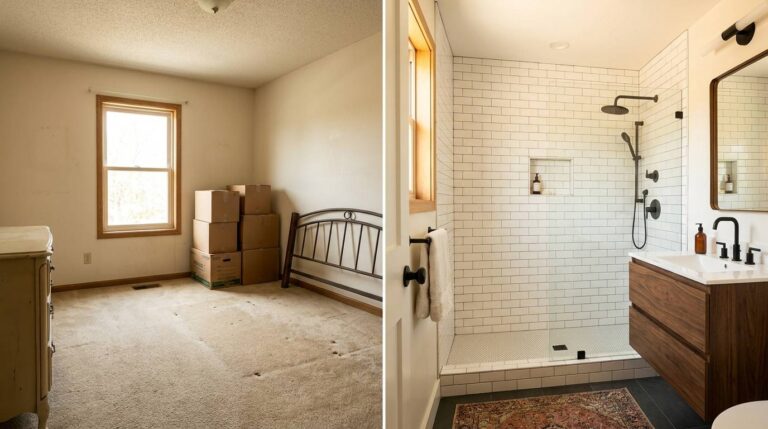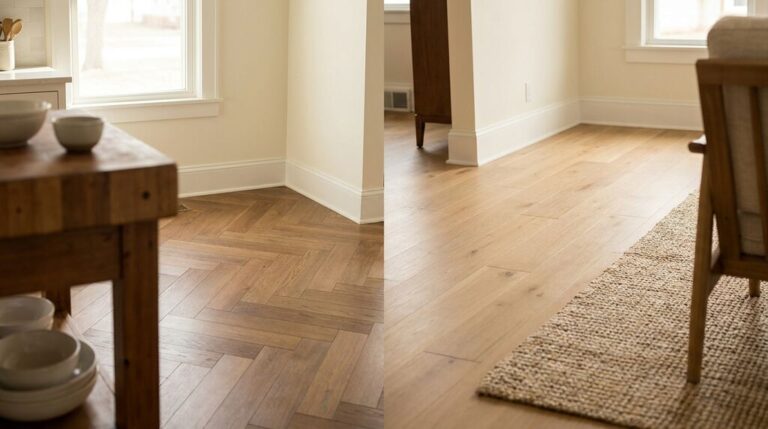
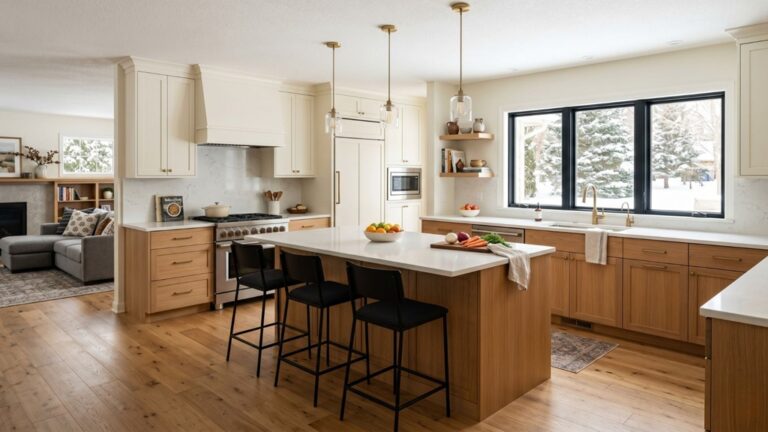
The Key Idea: A great kitchen remodel in the Twin Cities is never built to chase fleeting national aesthetics; it is engineered to survive Minnesota lifestyle realities. Weeks from now, forget the paint swatches and remember this: the projects that genuinely transform a home are the ones that prioritize structural flow, climate-resilient wood grains, and dedicated mudroom drop zones designed to handle six months of winter.
Your kitchen is the one room that has to do everything. Homework at the island. Sunday morning pancakes. A dinner party that spills from the counter to the living room. In Twin Cities homes, where winters run long and square footage runs tight, getting the kitchen right matters more than most rooms combined.
These 10 ideas come from projects we have done across Lakeville, Apple Valley, Eagan, Prior Lake, and Burnsville. Not trends we read about. Rooms we have built.
What Makes a Great Kitchen Remodel in the Twin Cities?
A great Twin Cities kitchen remodel solves the specific way Minnesota homeowners actually live. That means:
- storage for bulky winter gear stored near the entry,
- layouts that keep the kitchen warm and connected during the months you spend mostly indoors,
- finishes that hold up through freeze-thaw humidity cycles without warping or cracking.
Getting those things right takes more than a national design trend list.
The 2025 U.S. Houzz Kitchen Trends Study found that 86% of homeowners who remodel hire a professional for their kitchen project. Of those, design-build firms ranked among the most sought-after. The reason is straightforward: when design and construction live under one roof, fewer surprises show up midproject.
Wondering what your kitchen remodel will cost? Get a personalized estimate before you commit to anything. Use Our Free Remodeling Calculator
10 Kitchen Remodel Ideas for Twin Cities Homes
Some of these ideas are structural. Some are material choices. All of them come from real projects in Apple Valley, Eagan, Prior Lake, Lakeville, and Burnsville.
1. Open the Kitchen to the Living Space
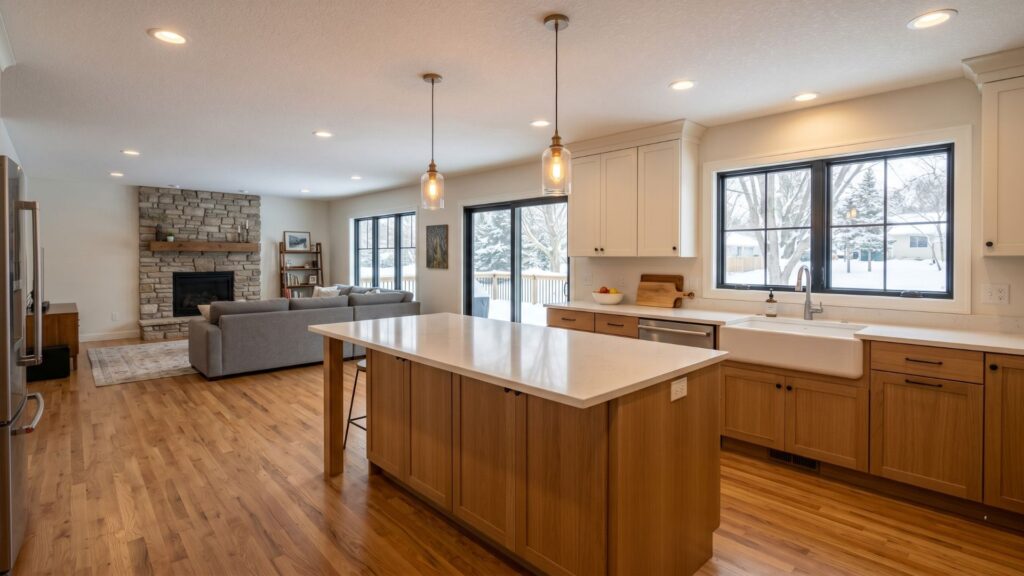
Opening a kitchen to the adjacent living or dining room is the most requested change we see in older Twin Cities homes. It transforms how the space feels during the months you spend indoors from October through April, and it makes the home feel larger without adding a single square foot.
Most homes in Eagan, Apple Valley, and Lakeville built between 1970 and 2000 were designed with closed, compartmentalized kitchens. Removing a non-load-bearing wall creates a fundamentally different house. If the wall is load-bearing, a properly engineered beam carries the load across the opening. We handle both.
The design payoff extends beyond just size. Natural light moves freely across both rooms. Conversations happen across the counter instead of through a doorway. The cook is part of the gathering instead of behind a wall.
According to the NKBA’s 2026 Kitchen Trends Report, 76% of industry professionals expect kitchen footprints to increase over the next three years, largely driven by homeowners sacrificing adjacent dining rooms for an expanded, connected kitchen zone.
Thinking about an open-concept change? See what our full kitchen service covers, including layout planning and structural work. Explore Our Kitchen Remodeling Services
2. A Kitchen Island Designed for How You Actually Use It
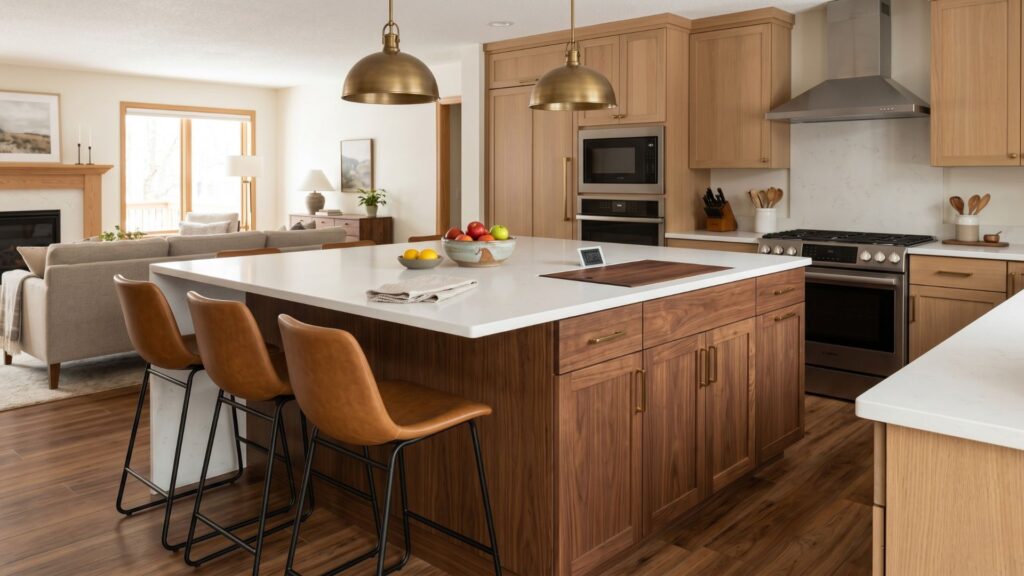
Not every island is worth building. A badly proportioned one blocks traffic flow, creates awkward corners, and collects clutter faster than any other surface in the house.
The islands worth building are the ones designed around real habits. Three kids doing homework while dinner is cooking needs knee space on one side and a full prep surface on the other. A couple who cooks together needs a second prep zone with its own drainage or cutting board. A family that entertains on weekends needs seating that faces the living room, not a wall.
We size islands to the kitchen’s actual dimensions, with a minimum 42 inches of clear floor space on working sides and 36 inches on seating sides. In smaller kitchens in Prior Lake or Burnsville where a full island does not fit, a rolling prep cart or a narrow peninsula delivers the same function in a fraction of the footprint.
The island also creates the natural separation between kitchen and living zone in open-concept layouts without needing a wall. That visual break makes both spaces feel more defined without closing them off.
3. White Oak Cabinetry and the End of All-White Kitchens
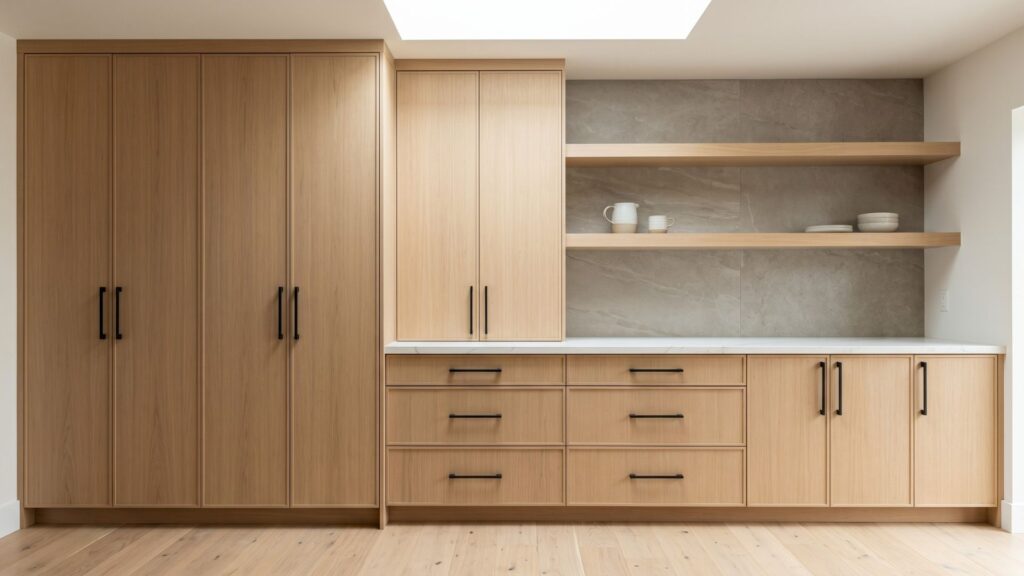
All-white kitchens had a good run. They are on the way out.
The NKBA’s 2026 report found that 59% of design professionals are seeing painted cabinets replaced by wood-grain finishes. White oak is the clear leader, cited by 51% of those respondents. We have seen this shift in our own projects across Lakeville and Apple Valley over the past two years.
The appeal makes sense. White kitchens show every smudge, every water spot, every scratch. Especially in homes with kids or dogs, the daily upkeep becomes exhausting. Wood-grain finishes hide the normal chaos of a working kitchen and look better as they age.
White oak in particular works well in Twin Cities homes because it reads warm without being heavy. Pair it with quartz countertops, matte black or brushed brass hardware, and wood floors, and the kitchen feels pulled together without trying too hard.
The full-height cabinet run without upper cabinets is another shift we are building more often. Floor-to-ceiling lower and tall cabinets create more storage than a standard upper cabinet layout, eliminate the awkward space between cabinet tops and the ceiling, and give the kitchen a cleaner profile.
4. A Functional Mudroom Entry off the Kitchen
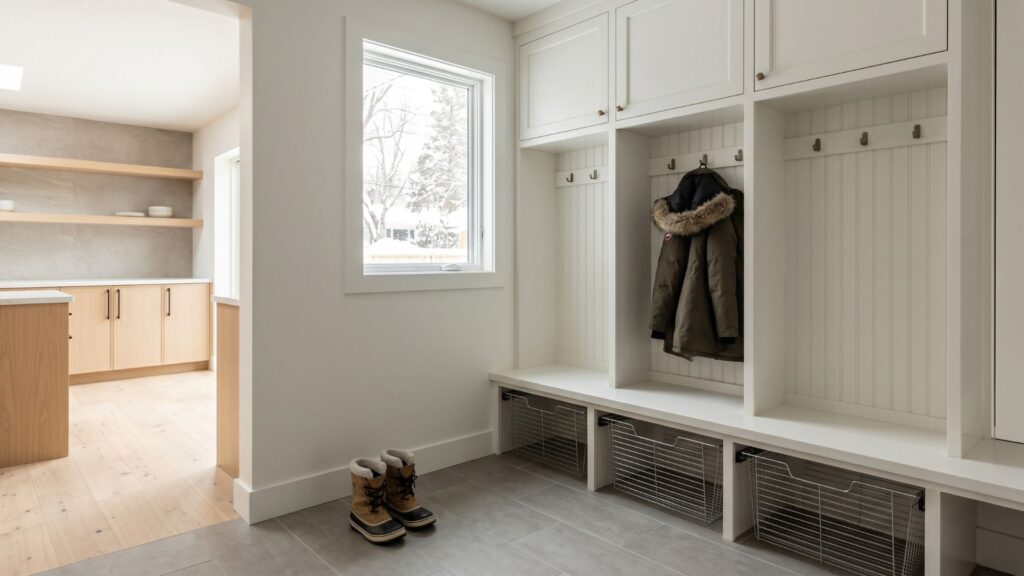
This one is uniquely Minnesota. In warmer climates, homeowners want a bigger pantry. In the Twin Cities, what most families actually need is a better place to land when they come inside from six months of winter.
The kitchen entry in most homes built in the 1980s and 1990s is a single door with a small mat and nowhere to put anything. Boots pile up on the floor. Coats hang on one hook that holds too many. Backpacks end up on the kitchen counter.
A dedicated mudroom zone off the kitchen changes this completely. Built-in lockers with a bench, hooks at the right heights, a cubby for each family member, tile floors that tolerate wet boots. In smaller footprints, we build a half-wall with coat hooks, a bench with shoe storage underneath, and a short run of cabinets for seasonal items.
This is the single upgrade that gets mentioned most often in project walkthroughs. Not the countertops, not the lighting, not the tile. The mudroom entry. Because it solves a real daily problem.
A mudroom entry works best when it is planned as part of the kitchen project, not added after. See how families are expanding their homes to make space for exactly this. Explore Home Addition Ideas for Your Family →
5. Full-Height Tile Backsplashes That Reach the Ceiling
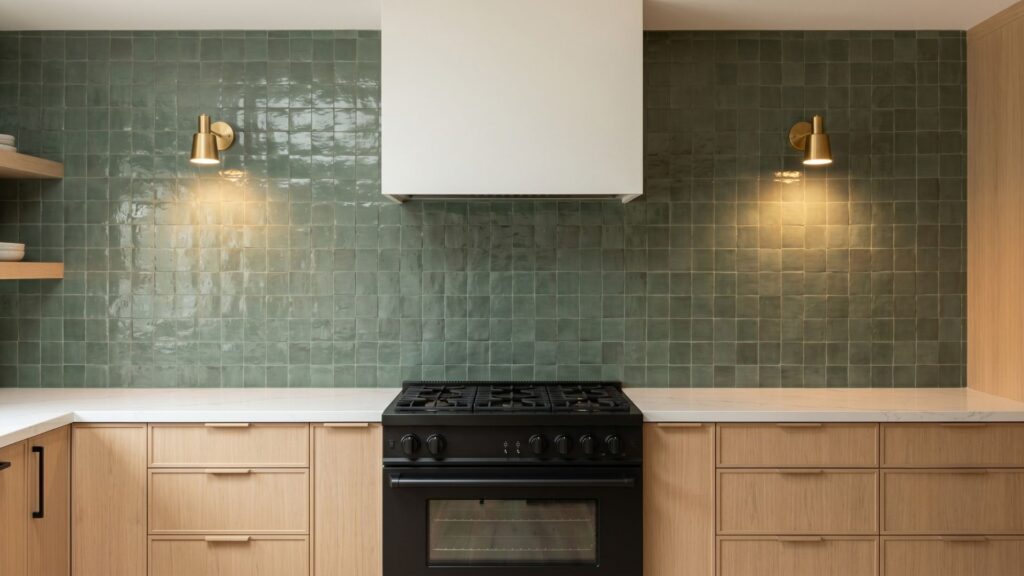
The 4-inch backsplash is a leftover from an era when tile was expensive and installation was measured by the square foot. Neither is true anymore.
The 2025 Houzz Kitchen Trends Study found that backsplash coverage extending to range hoods or upper cabinets jumped 5 percentage points in a single year to 67% of remodeled kitchens. Coverage going all the way to the ceiling increased to 12%. The reason is visual: a full-height backsplash gives the kitchen a designed, intentional feel that a standard 18-inch slab does not.
Large-format tiles, 12×24 or 24×48 inches, work especially well in this application. Fewer grout lines means less cleaning and a smoother visual surface. In kitchens with white oak cabinets, a warm neutral stone-look slab tile reads as sophisticated without competing for attention. In kitchens that want more personality, a painted zellige or handmade ceramic tile in deep green or terracotta reads as a genuine statement without requiring anything else in the room to justify it.
The choice of grout matters as much as the tile. Unsanded grout in a close-match color nearly disappears. Contrasting grout becomes part of the pattern.
6. A Dedicated Coffee Station or Beverage Zone
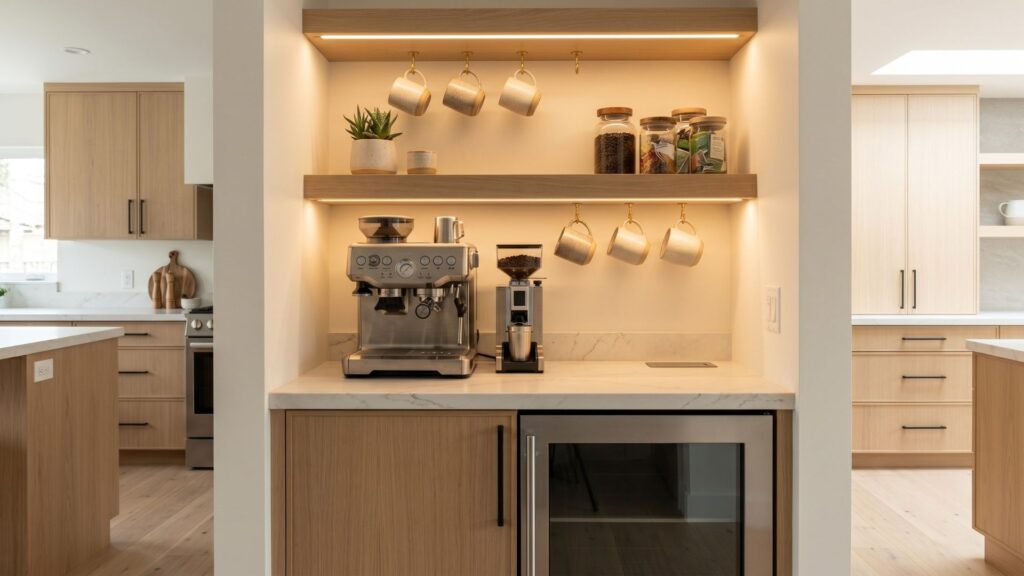
This has moved from a nice-to-have to something a large portion of homeowners specifically request.
A dedicated coffee or beverage zone removes the morning chaos from the main prep area. It keeps the primary counter clear for actual cooking. It gives whoever is up at 6am a place to do their thing without interrupting anything else.
In terms of construction, this usually means:
- a short run of lower cabinets with a countertop at a slightly lower height for easier appliance access,
- a dedicated 20-amp circuit for the espresso machine or coffee maker,
- an outlet in a logical position,
- open shelving above for mugs and canisters.
If space allows, a small beverage refrigerator underneath keeps water, sparkling water, or juice within reach. This is especially useful in homes with kids, who spend a significant portion of the day at the kitchen counter.
7. Smart Storage That Beats the Standard Cabinet
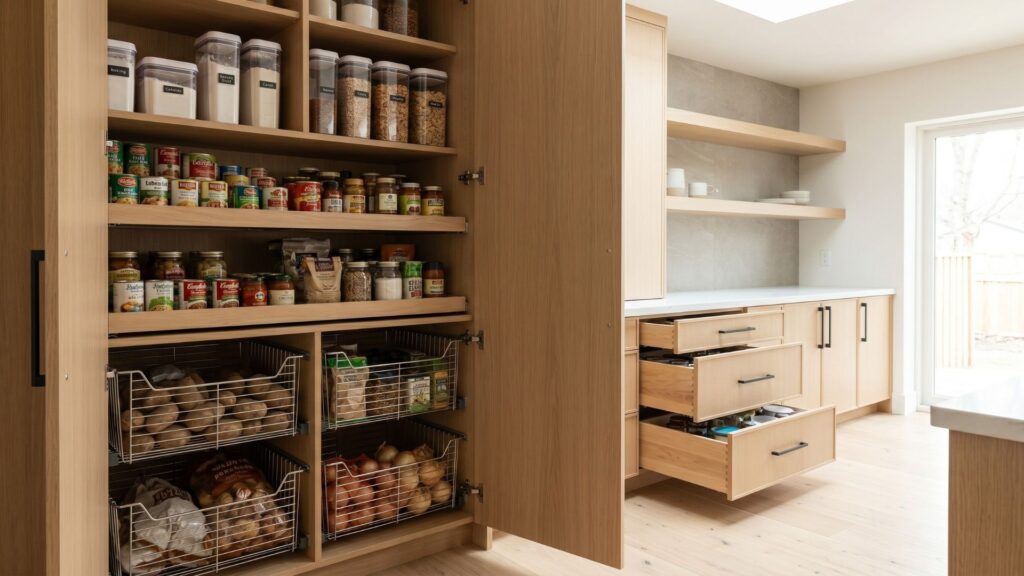
Standard kitchen cabinets waste more space than most homeowners realize. The back half of a base cabinet is nearly unreachable. The corner cabinet is a dead zone. The space above the refrigerator holds things nobody ever touches.
Smart storage is the upgrade that changes how usable the kitchen actually is, without changing its square footage at all.
What we build instead:
- full-extension drawers instead of lower cabinet doors,
- pull-out shelves in base cabinets,
- a floor-to-ceiling pantry tower with pull-out bins on the lower half and adjustable shelving above,
- a corner cabinet with a full-access pull-out unit that makes the entire corner reachable,
- a drawer immediately below the cooktop for lids, oils, and frequently used items.
In kitchens where a walk-in pantry is possible by borrowing space from an adjacent closet, that is almost always the right call. A 3×5 foot pantry with deep shelves holds more than an entire wall of standard cabinets, and it gets everything out of the main kitchen footprint.
See how we plan kitchen storage on our full-service kitchen page. Explore Our Kitchen Remodeling Services
8. Layered Lighting That Works at Every Hour
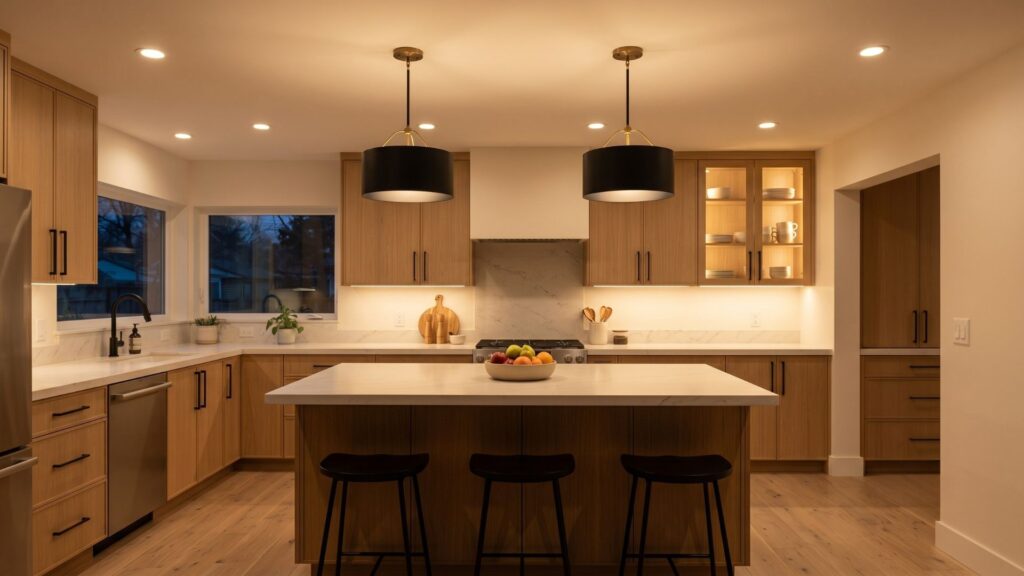
Most kitchens in homes built before 2005 have one ceiling fixture and nothing else. That one fixture creates shadows across the counter, washes out the space at night, and makes the kitchen feel flat regardless of how good the finishes are.
Layered lighting solves this in three levels.
Task lighting sits at counter height, typically LED strips mounted under upper cabinets or inside open shelving. This eliminates shadows on the workspace and is the single lighting upgrade with the most immediate practical impact.
Ambient lighting comes from recessed fixtures in the ceiling, positioned to wash the room evenly without creating hotspots. LED recessed lights on a dimmer give full control over the room’s energy throughout the day.
Accent lighting includes
- statement pendants over the island,
- lights inside glass-front cabinets,
- a fixture above the sink that treats that area as its own zone.
This is where the kitchen gets personality.
Because Minnesota winters mean spending a lot of hours inside under artificial light, getting the warmth of that light right matters. We use 2700K to 3000K color temperature consistently. Anything cooler reads as institutional in a home setting.
9. A Statement Range Wall That Anchors the Whole Kitchen
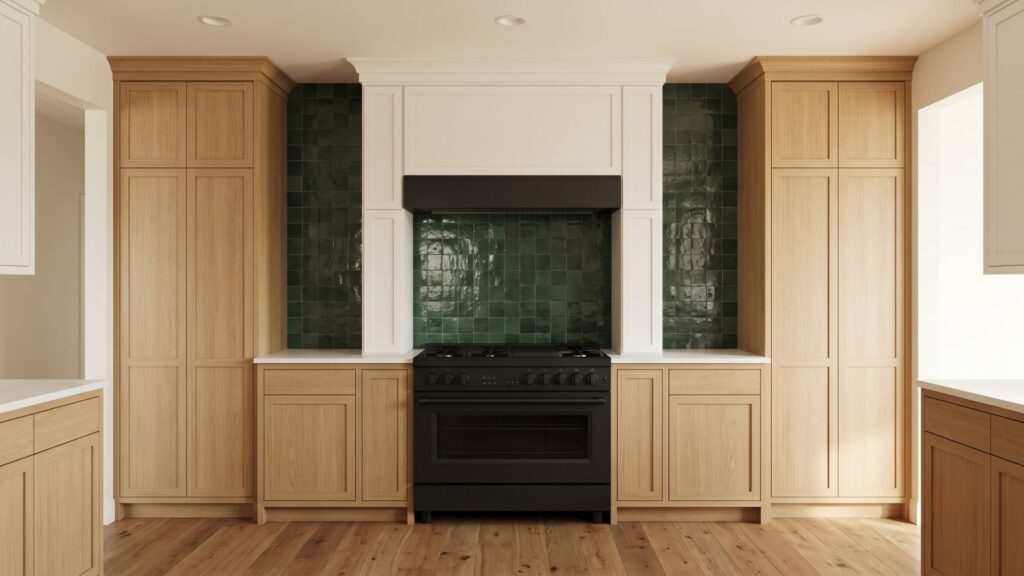
Every kitchen has a natural focal point. In most Twin Cities homes built in the last 40 years, that wall is wasted. A generic hood, a standard range, and whatever backsplash tile was on sale in 2003.
Turning the range wall into a deliberate statement changes how the entire kitchen reads.
The approach: a 36- or 48-inch professional-style range centered on the wall, flanked by cabinet towers on both sides, with a bold tile field running from counter to ceiling behind it. The hood gets treated as an architectural element, not an afterthought. A custom hood surround in painted wood, plaster, or stone ties the whole composition together and gives the room a clear visual center.
The tile behind the range is where the personality lives. Deep zellige in forest green or slate blue, large-format marble-look porcelain, or a hand-painted tile pattern all read differently but accomplish the same thing: they tell you exactly where you are in the room the moment you walk in.
In a kitchen that is otherwise transitional and restrained, this one wall carries the design. You do not need bold choices everywhere. One well-executed statement wall does more than five subtle upgrades scattered across the room.
The practical layer matters too. A properly vented hood rated for the range’s BTU output makes a real difference in a Minnesota home where cooking smells and steam build up fast during the months the windows stay closed.
Wondering how long a full kitchen remodel takes when it includes work like this? Read Our Kitchen Timeline Guide
10. Finishes That Hold Up to Minnesota’s Climate
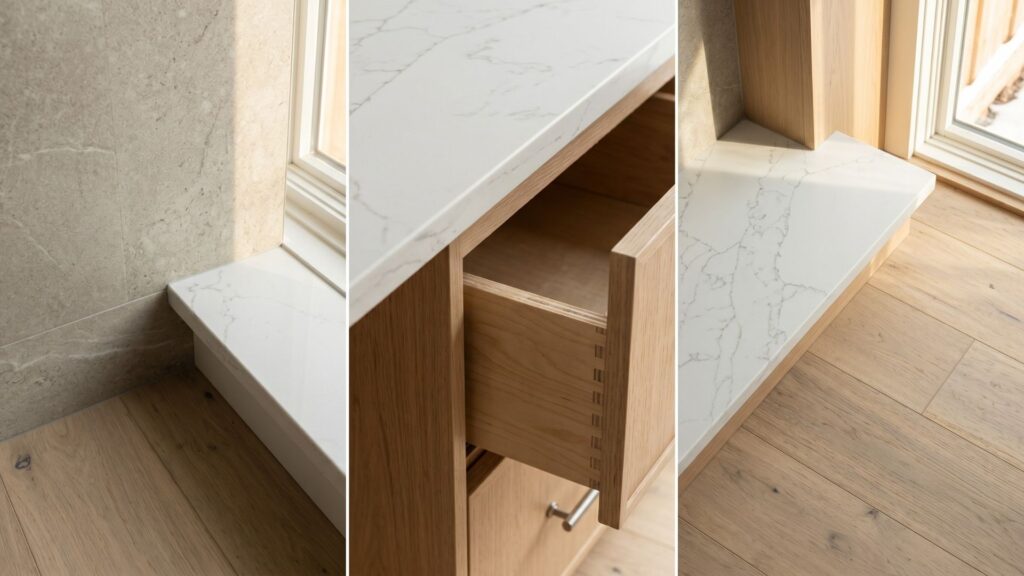
Minnesota puts materials through more than most states. The freeze-thaw cycle, humidity swings from summer to winter, and the dry air from forced-air heating create conditions that degrade certain finishes faster than their product specs suggest.
Painted cabinet finishes in high-traffic areas, especially around the dishwasher and sink, tend to chip and peel in Twin Cities homes within three to five years. Thermofoil cabinets delaminate near heat sources. Natural stone countertops that are not properly sealed absorb staining from coffee and red wine faster in a dry environment.
What holds up:
- Quartz countertops, which require no sealing and resist both moisture and temperature variation.
- Wood-look LVP flooring, which is waterproof and dimensionally stable across humidity cycles.
- Cabinet boxes built from plywood rather than MDF, which hold screws better over time and do not swell when moisture enters.
- Hardware in brushed finishes, which hide fingerprints and do not require polishing.
Twin Cities Kitchen Remodel: Scope, Cost, and Project Reality
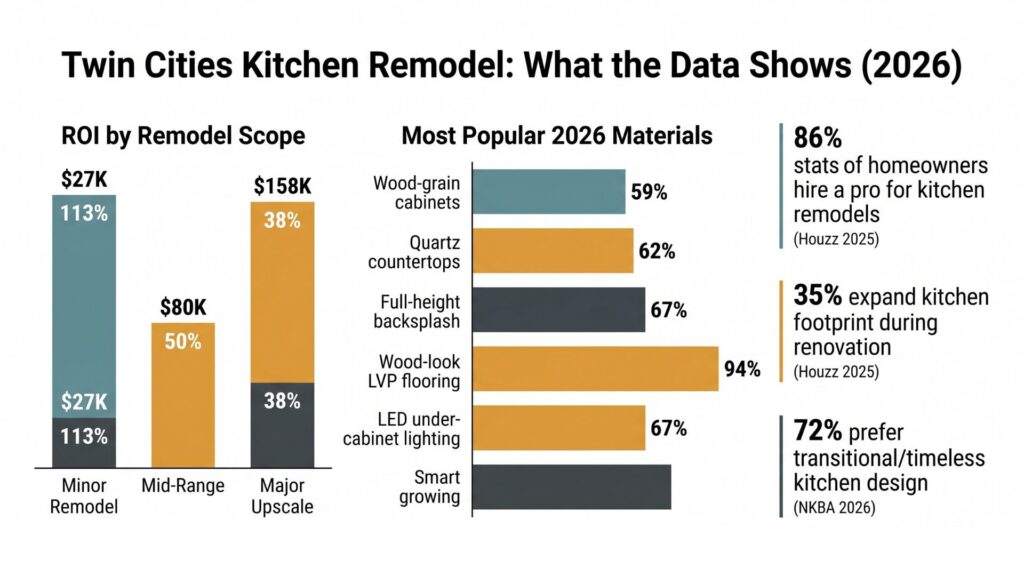
Use this table to size your project before the first conversation. These figures reflect 2026 labor and materials pricing specific to the Twin Cities metro.
| Project Scope | Typical Twin Cities Cost | Labor Share of Total | Permit Required? | Avg. Timeline (Demo to Punch List) | Median Resale Value Added |
|---|---|---|---|---|---|
| Cosmetic refresh (countertops, hardware, backsplash, paint) | $12,000 – $22,000 | 30–35% | No | 2–4 weeks | $8,000 – $15,000 |
| Minor remodel (cabinet fronts, countertops, appliances, lighting) | $27,000 – $45,000 | 35–40% | Sometimes (electrical) | 4–7 weeks | $28,000 – $42,000 |
| Mid-range full remodel (new cabinets, layout unchanged, updated mechanical) | $55,000 – $85,000 | 40–45% | Yes | 8–12 weeks | $45,000 – $65,000 |
| Major remodel (layout change, structural work, custom cabinetry) | $85,000 – $130,000 | 45–50% | Yes | 12–18 weeks | $55,000 – $80,000 |
| High-end custom (full gut, premium finishes, addition or expansion) | $130,000 – $200,000+ | 45–50% | Yes | 16–26 weeks | Varies by neighborhood ceiling |
What Does a Kitchen Remodel Cost in the Twin Cities?
A minor kitchen refresh in the Twin Cities, covering new cabinet fronts, countertops, appliances, and backsplash, runs $27,000 to $45,000. A mid-range full remodel with new cabinets, layout changes, and updated electrical typically runs $55,000 to $85,000. A high-end project with custom cabinetry, structural changes, and premium finishes starts around $100,000.
The 2025 Cost vs. Value Report from Zonda shows that minor kitchen remodels continue to deliver over 100% ROI nationally, making them the top-performing interior remodeling project for resale. The return comes from updating the most-scrutinized room in any home sale without triggering diminishing returns from over-investment.
Frequently Asked Questions About Kitchen Remodels in the Twin Cities
Can I live in my home during a kitchen remodel in Minnesota?
Most homeowners stay in their home during a kitchen remodel. The key is planning a temporary kitchen setup before demo starts: a folding table, a microwave, a coffee maker, and a mini fridge in a spare room or garage. Contractor-grade dust barriers contain the work zone, but expect some noise from 7am to 5pm on weekdays. The hardest period is usually the first two weeks, when demolition and rough mechanical work overlap and the room is fully unusable.
What kitchen layout works best in a split-level or rambler in the Twin Cities?
Ramblers and split-levels built across the Twin Cities from the 1960s through the 1980s typically have a galley or closed U-shaped kitchen with a separate dining room directly adjacent. The most effective layout change for these homes is removing the wall between the kitchen and dining area to create an L-shaped or open-concept kitchen with an island. This uses the existing square footage of both rooms more efficiently than expanding the kitchen footprint alone.
How much does cabinet installation labor cost in the Twin Cities?
Cabinet installation labor in the Twin Cities metro runs $75 to $120 per linear foot on top of the cabinet materials cost. A standard 20-foot kitchen requires roughly $1,500 to $2,400 in installation labor alone, not including countertop fabrication, backsplash tile, or plumbing reconnection. Custom cabinetry from a local shop runs higher on both material and labor than semi-custom from a national supplier, but delivers better box construction and fit in unusual layouts.
Is radiant floor heating worth adding during a kitchen remodel in Minnesota?
If the subfloor is already exposed during a full remodel, adding electric radiant heat under tile or LVP flooring costs $800 to $1,500 for a standard kitchen footprint and adds meaningful daily comfort during Minnesota winters. Hydronic radiant heat requires a boiler connection and is rarely cost-effective to add during a kitchen-only remodel unless the home already has a hydronic system. For most Twin Cities homeowners, the electric mat system under tile is the practical option.
What should I do if my kitchen remodel uncovers knob-and-tube wiring?
Knob-and-tube wiring is common in Twin Cities homes built before 1950, particularly in Minneapolis neighborhoods like South Minneapolis, Kenwood, and Linden Hills. Discovering it during a kitchen remodel typically requires a licensed electrician to assess the extent of the system and bring the kitchen circuit up to current code. Most homeowners in this situation upgrade the kitchen panel circuit fully while the walls are open, which adds $2,000 to $5,000 to the project cost but eliminates a future hazard and satisfies insurance requirements.
What countertop material holds up best around a kitchen sink in a Minnesota home?
Quartz is the most forgiving countertop material at the sink zone in Minnesota homes. It does not require sealing, resists moisture from daily use, and does not shift with the humidity swings between Minnesota summers and dry, heated winters. Natural marble stains quickly near a sink without rigorous sealing. Butcher block around the sink requires consistent oiling to prevent cracking in dry winter conditions. Honed quartz in a warm white or greige tone is what we specify most often in the Twin Cities for sink perimeters precisely because it requires nothing from the homeowner to maintain.
Ready to Start Your Twin Cities Kitchen Remodel?
Most homeowners spend six months to two years thinking about a kitchen remodel before the first phone call. You probably know what is not working. You may have a sense of what you want. What you need next is someone to look at the actual space, understand the scope, and give you a real number.
That is where we start every project.