What You Need to Know Now About a Basement Remodel in Minneapolis
- The Reality of Cost: A professional basement remodel in Minneapolis typically costs between $35,000 and $85,000+, with high-end suites involving bathrooms and wet bars reaching the upper end of that range.
- The 12-Week Rule: From the moment the first permit is pulled to the final walkthrough, you should plan for a construction timeline of 10 to 14 weeks to ensure the job isn’t rushed.
- The Moisture Warning: In the Twin Cities, skipping specialized sub-flooring or high-grade insulation is a recipe for a moldy, expensive disaster within three years.
- Equity Gains: While costs are rising, a well-executed lower-level finish currently recovers roughly 70-75% of its value in immediate home equity, making it the most cost-effective way to add square footage.
I’ve been working on basement remodels in the Twin Cities for over 15 years. I’ve seen projects go beautifully and projects go sideways. The difference isn’t usually the budget; it’s the planning. Let me walk you through what actually happens during a Minneapolis basement remodel, what it really costs, and how to do it right.
What Happens If I Finish My Basement Without a Permit in Minnesota?
Let’s start with the question nobody wants to ask but everyone’s wondering about: can you skip permits?
Short answer: legally, no. Practically? Also no, and here’s why it’ll cost you more than you save.
Minnesota state law and Minneapolis city code require building permits for basement finishing work that includes:
- Framing new walls or rooms
- Adding or relocating electrical circuits
- Installing plumbing (bathrooms, wet bars, kitchenettes)
- HVAC modifications or additions
- Egress windows (required for bedrooms)
Need help navigating Minneapolis basement finishing codes and permits? Our team at College City Design Build handles all permitting and inspections as part of every basement remodeling project.
What Can a Homeowner Do Without a Permit in MN?
Here’s what you can do yourself in Minnesota without pulling permits:
Cosmetic work only:
- Painting walls and ceilings
- Installing flooring over existing subfloor (carpet, vinyl planks, laminate)
- Hanging drywall over existing framed walls (as long as you’re not moving/adding walls)
- Installing trim, molding, or baseboards
- Minor plumbing repairs (replacing a faucet, fixing a leaky pipe)
- Replacing light fixtures (not adding new circuits or outlets)
What crosses into permit territory:
- Framing any new walls (even non-load-bearing partition walls)
- Adding electrical outlets, switches, or circuits
- Installing new plumbing fixtures (sinks, toilets, showers)
- Moving or modifying HVAC ducts
- Cutting into foundation walls for egress windows
- Structural work of any kind
The line is simple: if you’re changing the footprint, utilities, or structure, you need a permit. If you’re just refreshing surfaces, you don’t.
Why Minnesota is strict about basement permits:
Minnesota’s building code exists because we have specific challenges other states don’t face: frost heaves that crack foundations, extreme temperature swings that stress HVAC systems, and heavy snow loads that require proper structural support. Unpermitted basement work often ignores these factors, creating safety issues and expensive failures.
Egress windows are a perfect example. Minnesota requires basement bedrooms to have windows large enough for emergency escape (44 inches minimum). DIYers skip this because the windows cost $3,000-$5,000 installed. Then someone gets trapped in a basement fire. The code exists for a reason.
Planning Your Minneapolis Basement Remodel: What You’ll Actually Use It For
Before you call contractors or start picking flooring, figure out what you’re actually building. “Finish the basement” isn’t a plan. It’s a vague goal that leads to wasted space and buyer’s remorse.
The most functional basement remodels in Minneapolis homes include:
1. Family Room / Entertainment Space
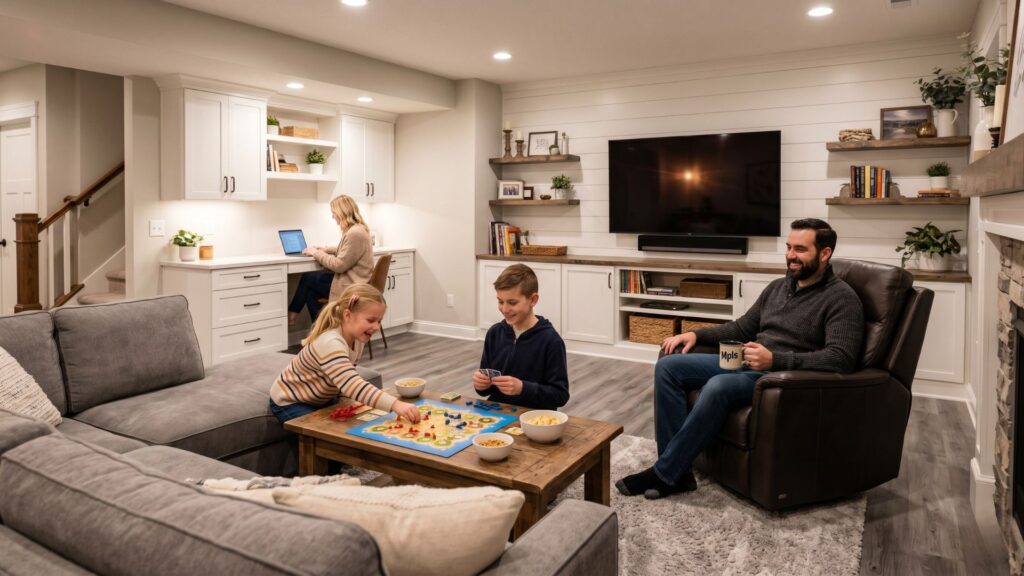
This is the most common use case, and for good reason. Kids need somewhere to play that isn’t your living room. Teenagers need their own space. Adults want somewhere to watch movies without waking sleeping children.
What this includes:
- Large open area (300-600 square feet)
- Built-in entertainment center or media wall
- Comfortable seating
- Good lighting (overhead plus lamps — basements need more light than upstairs rooms)
- Sound considerations (insulation in ceiling to prevent noise traveling upstairs)
Cost estimate: $25,000-$45,000 depending on size and finishes
2. Guest Suite with Bathroom
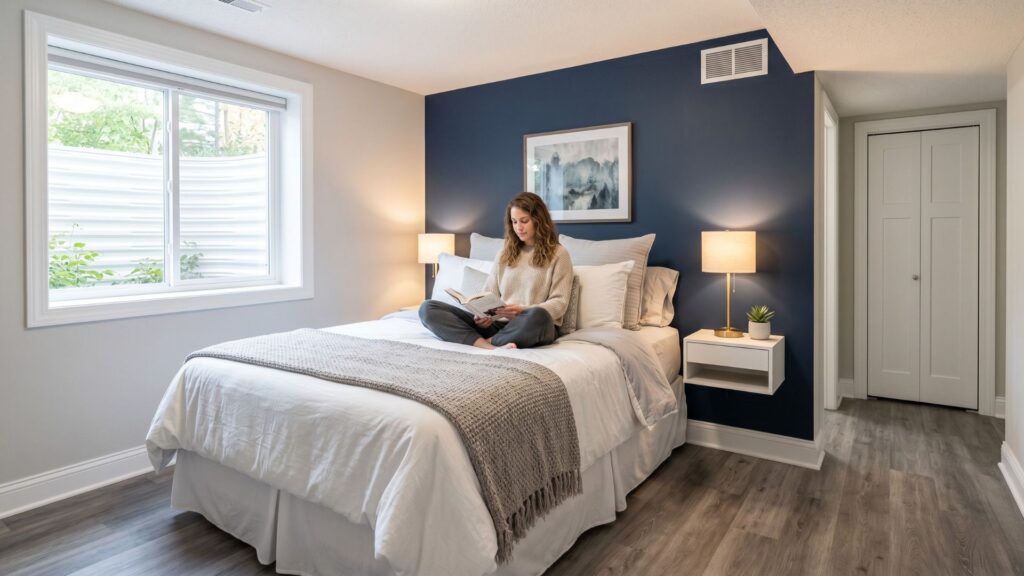
Adding a bathroom transforms your basement from “extra space” to “actual living quarters.” This is especially valuable for multi-generational households or frequent guests.
Requirements:
- Bedroom area with egress window (legally required)
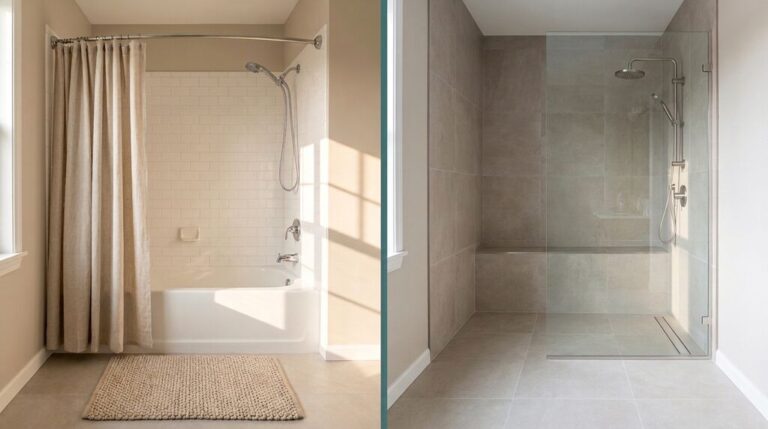
- Full bathroom with shower
- Closet space
- Privacy from main entertainment area
Cost estimate: $45,000-$75,000 (bathroom adds $18,000-$35,000)
Looking for bathroom layout ideas? Check out our guide on adding a bathroom to your basement with realistic Minneapolis costs.
3. Home Office / Workspace
Remote work turned basements into home offices. If you’re working from home 3+ days per week, a dedicated basement office keeps work separate from living space.
What works:
- Quiet area away from entertainment zones
- Adequate electrical outlets (plan for computer, monitors, printer, desk lamp)
- Good internet connectivity (check signal strength before finishing)
- Natural light if possible (ground-level windows)
- Climate control (basements run cooler — budget for HVAC adjustments)
Cost estimate: $15,000-$30,000 for office area within larger basement finish
4. Wet Bar / Entertainment Hub
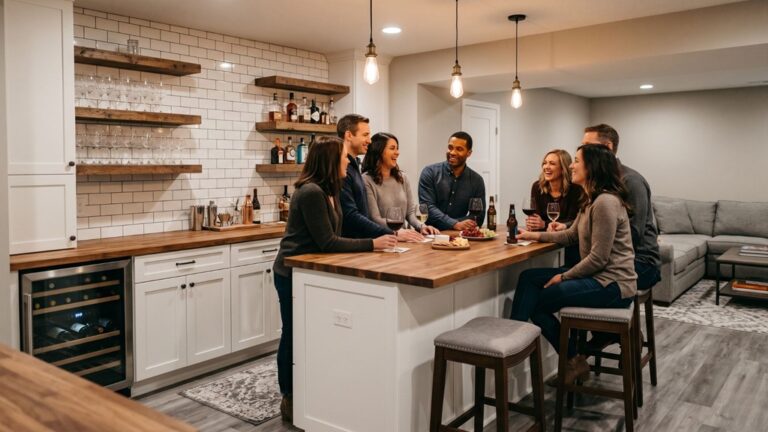
Wet bars add functionality for entertaining and surprisingly strong resale value in the Twin Cities market.
Components:
- Small sink with plumbing
- Beverage fridge or wine cooler
- Storage for glasses and bottles
- Counter space for prep
- Proximity to seating area
Cost estimate: $8,000-$18,000 as add-on to basement finish
Want design inspiration? Our basement bar ideas guide shows Minneapolis projects with photos and layouts.
Minneapolis Basement Remodel Costs: The Real Numbers
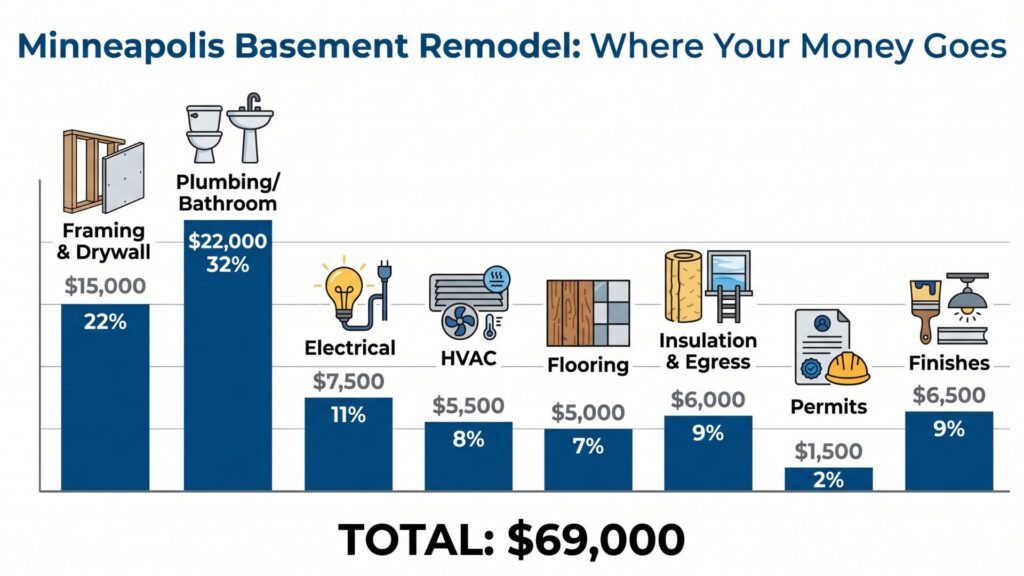
Here’s what you’ll actually spend based on projects we’ve completed in Minneapolis, St. Louis Park, Edina, and surrounding Twin Cities suburbs.
For a standard 800-square-foot basement finish:
| Component | Budget Range | Mid-Range | High-End | What You Get |
|---|---|---|---|---|
| Design & Planning | $0-$500 | $500-$2,000 | $2,000-$5,000 | DIY layout vs contractor design vs architect drawings |
| Permits & Inspections | $800-$1,200 | $1,200-$1,800 | $1,800-$2,500 | Varies by scope and city (Minneapolis vs suburbs) |
| Framing & Drywall | $8,000-$12,000 | $12,000-$18,000 | $18,000-$25,000 | Basic partition walls vs soundproofing vs custom features |
| Electrical | $3,500-$6,000 | $6,000-$9,000 | $9,000-$15,000 | Code-minimum outlets vs recessed lighting vs smart home |
| Plumbing (if bathroom) | $0 | $18,000-$25,000 | $25,000-$40,000 | No bathroom vs 3/4 bath vs full bath with tub |
| HVAC | $2,500-$4,000 | $4,000-$7,000 | $7,000-$12,000 | Extend existing vs new zone vs mini-splits |
| Flooring | $2,400-$4,000 | $4,000-$7,000 | $7,000-$12,000 | Basic carpet/LVP vs upgraded LVP vs tile/hardwood |
| Insulation | $1,500-$2,500 | $2,500-$4,000 | $4,000-$6,000 | Code minimum vs enhanced R-value vs spray foam |
| Windows & Egress | $0-$3,000 | $3,000-$6,000 | $6,000-$10,000 | No bedroom vs one egress vs multiple egress windows |
| Finishes & Trim | $2,000-$4,000 | $4,000-$7,000 | $7,000-$12,000 | Basic vs upgraded doors, trim, paint quality |
| Wet Bar (optional) | $0 | $8,000-$12,000 | $12,000-$20,000 | None vs basic vs custom cabinetry |
| Contractor Overhead | Built into above | Built into above | Built into above | Project management, insurance, warranty |
| TOTAL (no bathroom) | $35,000-$45,000 | $55,000-$70,000 | $80,000-$110,000 | Complete basement finish |
| TOTAL (with bathroom) | $48,000-$65,000 | $70,000-$90,000 | $100,000-$140,000 | Complete basement with full bath |
Minneapolis-specific cost factors:
Minneapolis basements cost 15-20% more than suburban projects due to:
- Stricter permitting requirements and longer approval times
- Limited contractor parking (street permits required)
- Older homes (pre-1950) with foundation issues requiring waterproofing
- Lead paint remediation in homes built before 1978 (adds $2,000-$5,000)
- Asbestos abatement if disturbing old insulation or tiles (adds $3,000-$8,000)
What drives your cost up or down:
Lower cost scenarios:
- Rectangular basement with no support posts
- No bathroom or wet bar
- Existing HVAC has capacity for basement load
- No moisture issues requiring waterproofing
- DIY-ing demolition, painting, and trim work
Higher cost scenarios:
- Irregular layout with support columns requiring creative design
- Adding full bathroom with tub
- Separate HVAC zone or mini-splits needed
- Foundation cracks or water intrusion requiring repair
- Custom built-ins, bars, or entertainment centers
- Soundproofing for music room or home theater
For a detailed breakdown of basement finishing costs, timelines, and what to expect, read our complete basement finishing guide.
What Not to Do When Finishing a Basement (Common Mistakes)
After 15+ years of basement remodels, I’ve seen the same mistakes repeatedly. Here are the ones that cost the most money or create the biggest headaches:
1. Ignoring Moisture Issues
The mistake: Finishing over damp walls or floors without addressing the source.
Why it matters: Mold grows behind finished walls where you can’t see it. By the time you notice the musty smell, you’ve got a $5,000-$15,000 mold remediation problem plus re-doing all the drywall.
The fix: Before finishing, run a dehumidifier for 2-3 days with all basement windows and doors closed. Check for condensation on walls and floors. If you find moisture, hire a waterproofing specialist to identify and fix the source. This costs $1,500-$8,000 depending on the problem, but it’s mandatory.
Minneapolis note: Our freeze-thaw cycles create unique foundation stress. Even homes without obvious leaks can develop cracks over winter. Have a foundation specialist inspect before finishing.
2. Skimping on Insulation
The mistake: Using minimum code-required R-13 insulation to save $800-$1,200.
Why it matters: Minneapolis winters are brutal. Under-insulated basements feel cold even with heat running, your HVAC system runs constantly trying to maintain temperature, and your energy bills spike. Plus, the space becomes uncomfortable November through March — exactly when Minnesotans use basements most.
The fix: Upgrade to R-19 or R-21 insulation in exterior walls. Add insulated ceiling if you want soundproofing from upstairs noise. The extra $1,500-$2,500 pays back in 3-4 years through lower heating costs.
3. Inadequate Lighting
The mistake: Relying on a few overhead fixtures because “basements are supposed to be dim.”
Why it matters: Dark basements feel depressing. Nobody wants to spend time there. You just spent $60,000 finishing it and nobody uses it.
The fix: Layer your lighting: recessed can lights every 6-8 feet, task lighting over bars/desks, accent lighting for built-ins, and multiple lamps. Budget 1.5x-2x the lighting you’d use upstairs. Basements have limited natural light — you need to compensate.
4. Forgetting Future Access Needs
The mistake: Drywalling over your main water shutoff, sewer cleanout, or electrical panel access.
Why it matters: When your water heater fails at 10 PM on a Saturday (it will), the plumber needs to access your shutoff valve. If it’s behind finished drywall, they’re cutting holes or you’re flooding. Same with sewer cleanouts when you have a backup.
The fix: Install access panels over any critical utilities. These cost $50-$150 each and save you $500-$2,000 in emergency drywall repair.
5. Wrong Flooring Choices
The mistake: Installing hardwood, solid wood laminate, or non-waterproof flooring directly on concrete.
Why it matters: Basements have higher humidity than upstairs. Even without leaks, concrete naturally allows moisture vapor transmission. Hardwood cups and warps. Laminate without moisture barriers swells and buckles.
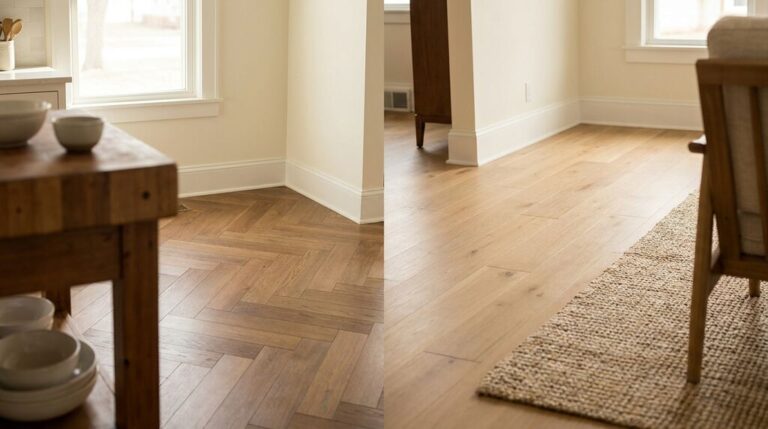
The fix: Use waterproof luxury vinyl plank (LVP), tile, or engineered wood specifically rated for below-grade installation. If you must have the hardwood look, use engineered wood with vapor barrier underlayment. Add $2-$4 per square foot for proper moisture protection, but your floor will last 20+ years instead of failing in 3-5.
6. Cheap Doors on Bedrooms
The mistake: Using hollow-core doors to save $200-$400.
Why it matters: Sound travels easily through hollow doors. Your guest bedroom or teen’s room has zero privacy for noise. Every conversation, every movie, every phone call echoes through the basement.
The fix: Install solid-core doors on all bedrooms and bathrooms. They cost $150-$300 vs $60-$100 for hollow doors, but the sound dampening is worth it. Combine with door sweeps and you’ll actually have functional bedrooms.
7. Undersized HVAC
The mistake: Assuming your existing furnace and AC can handle basement load without checking.
Why it matters: Most furnaces are sized for the home as originally built. Adding 800 square feet of finished basement increases your HVAC load by 20-30%. If your system can’t handle it, the basement stays too hot in summer and too cold in winter. Running the system harder to compensate burns out the unit faster.
The fix: Have an HVAC technician calculate your heat load with the basement finished. If your current system is maxed out, budget $4,000-$8,000 for mini-splits or a separate zone system. This seems expensive until your basement is comfortable year-round.
Can You Put a Shower and Toilet in a Basement? (Is It Worth It?)
You can absolutely add a full bathroom with shower and toilet to a Minneapolis basement. Most homes built after 1980 have rough-in plumbing for basement bathrooms (check for capped pipes sticking up through your basement floor near where you’d want the bathroom). Even without rough-in, it’s doable, but it just costs more.
When it’s worth it:
- You’re creating a guest suite or in-law quarters. A bedroom without a bathroom is inconvenient. Guests using your main floor bathroom at 2 AM disrupts everyone. The bathroom makes the space genuinely functional.
- You’re finishing the basement as entertainment space. If you’re hosting game nights, movie marathons, or parties, nobody wants to run upstairs to use the bathroom every hour. A basement bathroom keeps everyone downstairs.
- You have teenagers. Give them their own bathroom and your main floor bathroom conflicts drop dramatically. Worth every penny.
- Resale value matters. Basements with bathrooms sell faster and for 8-12% more than similar homes with finished basements but no bathroom. On a $400,000 home, that’s $32,000-$48,000 in value for a $25,000-$35,000 investment.
When you might skip it:
- You already have 2.5+ bathrooms upstairs
- The basement will primarily be storage or occasional use (home gym that only one person uses)
- Your budget is maxed out and you need to choose between bathroom or finishing more square footage
- The main sewer line is positioned badly and adding a bathroom requires $15,000+ in plumbing work
Our basement bathroom addition guide covers layouts, ejector pump systems, and realistic costs for Minneapolis homes.
Minneapolis Basement Remodel Timeline: What to Expect
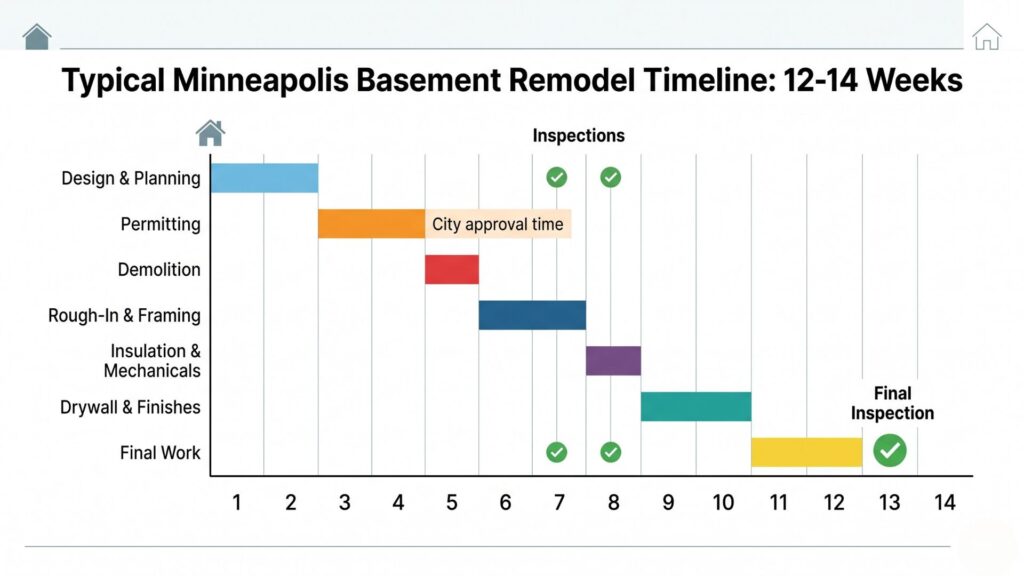
Total timeline: 10-16 weeks from initial consultation to final walkthrough
Here’s the realistic week-by-week breakdown:
Weeks 1-2: Planning & Design
- Initial consultation and site visit
- Measurements and assessment of existing conditions
- Design/layout development
- Material selections
- Detailed estimate and contract
Weeks 3-4: Permitting
- Submit permit applications to Minneapolis Building Inspection
- Wait for permit approval (Minneapolis typically takes 10-15 business days)
- Schedule inspections
Week 5: Demolition & Prep
- Remove existing materials (old paneling, drop ceiling, damaged drywall)
- Address any moisture issues discovered
- Install dehumidifier if needed
Weeks 6-7: Rough-In Work
- Frame walls and install door frames
- Run electrical wiring for outlets, switches, lights
- Run plumbing for bathroom/wet bar if applicable
- Install/modify HVAC ductwork
- Install egress windows if needed
- First inspection: rough electrical and plumbing
Week 8: Insulation & Mechanicals
- Install insulation in exterior walls and ceiling
- Second inspection: insulation and energy compliance
- Install bathroom shower pan if applicable
Weeks 9-10: Drywall & Finishes
- Hang and finish drywall
- Prime walls
- Install doors and trim
- Tile work in bathroom if applicable
Weeks 11-12: Final Finishes
- Paint walls and trim
- Install flooring
- Install light fixtures, outlets, switches
- Install plumbing fixtures (toilet, vanity, shower)
- Install HVAC registers
- Final inspection
Week 13: Punch List & Completion
- Address any punch list items from final inspection
- Final cleanup
- Walkthrough with homeowner
What adds time:
- Moisture remediation: +1-3 weeks if foundation repairs needed
- Custom millwork: +2-4 weeks for built-in bars, entertainment centers, custom shelving
- Supply delays: +1-3 weeks if materials back-ordered (tile, specific fixtures, custom doors)
- Failed inspections: +1-2 weeks per re-inspection cycle
- Winter weather: Projects in January-February can extend 1-2 weeks due to concrete curing issues and material delivery delays
Best time to start a Minneapolis basement remodel
April-May or September-October. You’ll get:
- Faster permit approvals (city isn’t backed up)
- Better contractor availability
- Ideal concrete curing conditions
- Completion before or after holidays
Avoid starting December-February unless you don’t mind potential weather delays.
Real Minneapolis Basement Remodel Examples
Project 1: South Minneapolis 1920s Bungalow
- Size: 650 sq ft
- Scope: Open family room, 3/4 bathroom, laundry area
- Challenges: Foundation cracks requiring sealing, lead paint remediation, undersized electrical panel requiring upgrade
- Timeline: 14 weeks
- Cost: $72,000
- Result: Functional guest suite that increased home value by $85,000
Project 2: Edina Split-Level (1970s)
- Size: 900 sq ft
- Scope: Entertainment area with wet bar, home office, storage room
- Challenges: Low ceiling height (7’2″), required creative lighting solutions
- Timeline: 11 weeks
- Cost: $58,000
- Result: Modern entertainment space with custom bar
See more basement remodeling projects in the South Metro at our Inver Grove Heights showcase.
Working with Basement Remodeling Contractors in Minneapolis
Questions to ask every contractor:
- Are you licensed and insured for Minnesota? (Verify at Minnesota Department of Labor and Industry)
- Will you pull all necessary permits? (If they say permits aren’t needed, walk away)
- How do you handle unexpected issues? (Foundation cracks, old wiring, moisture problems)
- What’s your payment schedule? (Never pay more than 10% upfront, avoid paying 50%+ before work starts)
- Can I see photos of 3 completed basement projects? (Look for finish quality, attention to detail)
Red flags:
- Pressure to skip permits “to save money”
- Unwilling to provide references
- No physical business address
- Asks for 50%+ payment upfront
- Can’t start for 6+ months (established contractors book 2-3 months out, not half a year)
- Dramatically cheaper than other bids (they’re cutting corners somewhere)
Green flags:
- Shows you past projects similar to yours
- Explains code requirements without you asking
- Proactively mentions moisture testing, radon, HVAC load calculations
- Provides detailed written estimate broken down by category
- Communicates clearly and answers questions thoroughly
Basement Remodeling Financing Options
Most homeowners don’t pay cash for basement remodels. Here are the common financing methods for Minneapolis projects:
Home Equity Line of Credit (HELOC)
- Borrow against your home’s equity
- Current Minneapolis rates: 8.5-10.5% (May 2026)
- Interest-only payments during draw period
- Best for: Homeowners with significant equity who want flexibility
Home Equity Loan
- Fixed-rate loan based on home equity
- Current Minneapolis rates: 8.0-9.5%
- Fixed monthly payments
- Best for: Homeowners who want predictable payments
Cash-Out Refinance
- Refinance your mortgage for more than you owe, take difference in cash
- Current rates: 6.5-7.5% depending on credit
- Best for: Homeowners with rates above 7% who want to refinance anyway
Personal Loan
- Unsecured loan based on creditworthiness
- Rates: 9-16% depending on credit score
- Best for: Smaller projects under $30,000
Contractor Financing
- Some contractors offer 0% financing for 12-24 months
- Read fine print carefully (deferred interest can be brutal)
- Best for: Homeowners who can pay off within promotional period
Frequently Asked Questions
Can you add a bedroom in a basement in Minneapolis?
Yes, but Minneapolis code requires basement bedrooms to have egress windows with minimum 5.7 square feet opening area, at least 44 inches wide, and maximum 44-inch sill height above floor. Egress windows cost $3,000-$6,000 installed including window well and drainage. Additionally, basement bedrooms need proper HVAC (heating and cooling), adequate lighting, and should be tested for radon before use. Without meeting egress requirements, you cannot legally call the space a bedroom even if it has a closet and door.
Is it worth it to finish a basement in Minnesota?
For most Minneapolis homeowners planning to stay 5+ years, finishing a basement returns 50-65% of cost at resale while providing immediate livable space worth far more in daily use. A finished basement adds approximately 10-15% to home value ($40,000-$60,000 on a $400,000 home) while costing $45,000-$75,000 to complete. The ROI improves significantly if you add a bathroom (increases value 8-12% more) or if you’re in a neighborhood where most comparable homes have finished basements. Skip basement finishing if you’re moving within 3 years, have chronic moisture issues requiring expensive foundation work first, or your home already exceeds neighborhood value norms.
What’s the best flooring for Minneapolis basements?
Waterproof luxury vinyl plank (LVP) is the best flooring for Minneapolis basements, costing $4-$7 per square foot installed. LVP handles basement humidity without warping, feels warmer than tile, installs directly over concrete with moisture barrier underlayment, and looks like hardwood without the moisture sensitivity. Porcelain tile is the second-best option at $6-$12 per square foot installed — completely waterproof but cold underfoot unless you add radiant floor heating ($8-$15 per square foot). Avoid hardwood, solid wood laminate, or carpet directly on concrete; all are prone to moisture damage, mold growth, and failure within 3-5 years in Minnesota’s climate.
Can I finish my basement myself to save money?
Minnesota allows homeowners to pull owner-builder permits for their own homes, letting you legally do basement finishing work yourself and save 30-40% on labor costs ($15,000-$25,000 on a typical project). However, you must still meet all code requirements, pass inspections, and complete work that meets safety standards. Most DIYers successfully handle demolition, painting, trim installation, and flooring but hire licensed professionals for electrical, plumbing, and HVAC work (required by code and for insurance coverage). Plan on dedicating 200-300 hours over 3-4 months if doing it yourself, and know that DIY mistakes often cost more to fix than hiring a professional initially.
Is It Healthy to Live in a Finished Basement?
This question comes up constantly, usually from parents wondering if a teenage bedroom in the basement is safe or from people considering in-law suites. A properly finished basement with adequate ventilation, moisture control, and egress windows is perfectly healthy. An improperly finished basement can cause respiratory issues, mold exposure, and radon accumulation.
How do I handle the low ceiling problem common in older Minneapolis homes?
Many older homes in neighborhoods like South Minneapolis or Northeast have ductwork and plumbing that create frustratingly low clearances. We solve this by “soffiting” around essential mechanicals or, in more intensive projects, rerouting plumbing lines into the joist bays to maximize every inch of vertical space. If your ceiling is exceptionally low, I often suggest using polished concrete or luxury vinyl plank flooring to avoid the “closed-in” feeling created by thick carpeting and pads.
What is the best way to prevent basement smell in a humid Minnesota summer?
The basement smell is almost always the result of moisture vapor wicking through your concrete slab and getting trapped under traditional flooring. To avoid this, we utilize a vapor barrier system and inorganic materials like closed-cell spray foam or rigid foam board insulation that doesn’t provide a food source for mold. Combining these professional-grade barriers with a high-capacity dehumidifier integrated into your HVAC system is the only way to ensure your new space feels as fresh as your upstairs living room.
Start Your Minneapolis Basement Remodel
A well-planned basement remodel transforms unused square footage into your family’s most-used space, whether that’s a guest suite for visiting relatives, a entertainment hub for weekend gatherings, or a home office that actually separates work from life.
The key is planning for how you’ll actually use it, not just checking a “finished basement” box. That means being honest about whether you need a bathroom, how much you’ll realistically spend time downstairs, and whether your home’s mechanical systems can support the added load.
Ready to explore your basement’s potential? College City Design Build specializes in Minneapolis basement remodels that combine thoughtful design with realistic budgets. We handle permitting, inspections, and code compliance so you don’t have to navigate Minneapolis building requirements alone.
Schedule a free basement consultation to discuss your project, get a detailed estimate, and see if a basement remodel makes sense for your home.